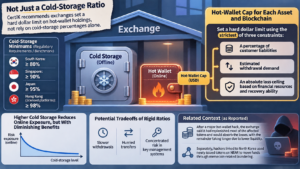
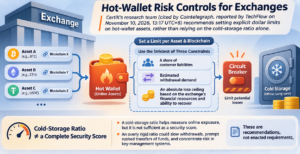
For people holding assets on an exchange, a high cold-storage percentage does not answer a practical question: how much remains exposed in hot wallets? In a report published on November 10, 2026, at 13:21 (UTC+8), BlockBeats relayed CertiK’s recommendation that exchanges set explicit dollar limits on hot-wallet holdings rather than rely on cold-storage ratios alone.
The recommendation followed an attack on a Binance hot wallet, as multiple exchanges disclosed cold-storage figures to reassure users. Gate said it held 88.26% of its total assets in cold wallets; Coinbase said more than 99% of customer assets were offline. Those figures describe different asset bases and are not directly comparable.
CertiK’s research team said cold-storage ratios show the extent of online exposure but should not serve as a security score by themselves. Raising the cold-storage share generally reduces online risk, it said, but further gains may be limited once the share is already high. An overly rigid ratio could also slow withdrawals, prompt rushed asset transfers or concentrate risk in key-management systems.
CertiK proposed separate hot-wallet limits for different assets and blockchains, taking account of three measures: a percentage of customer liabilities, expected withdrawal demand, and an absolute loss limit based on the exchange’s financial resources and ability to recover assets. It also recommended hard dollar caps and circuit breakers to limit potential losses while maintaining liquidity for withdrawals. These are recommendations, not enacted requirements.
Source: theblockbeats.info (originally published 2026-11-10 13:21 UTC+8)