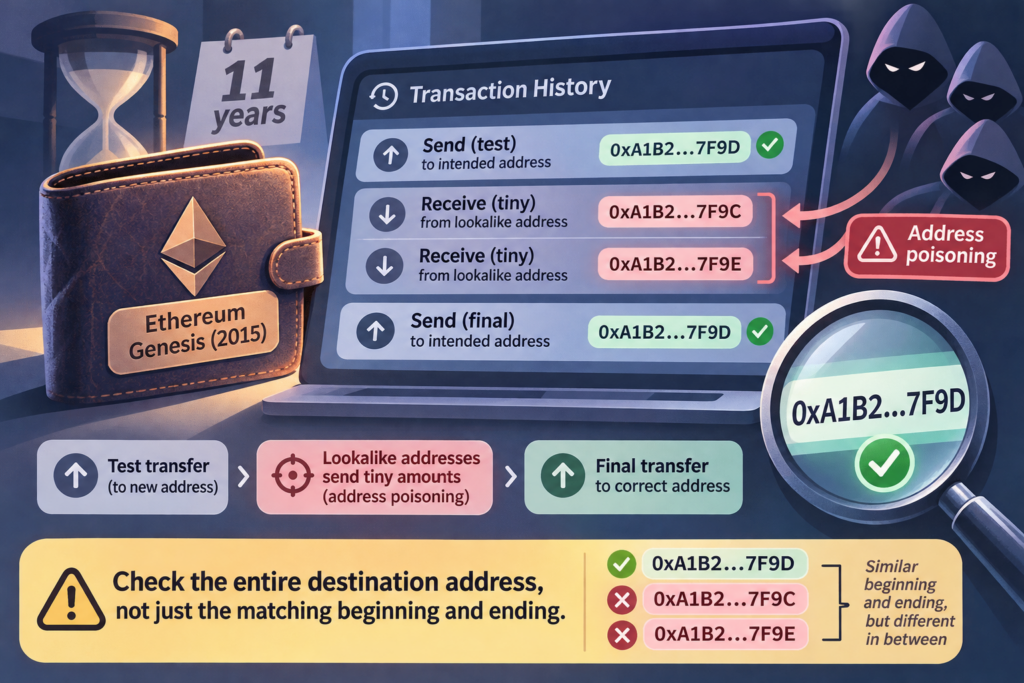
When sending funds from a long-held wallet, a familiar-looking address in transaction history may not be the intended destination. A wallet linked to Ethereum’s 2015 genesis block encountered that risk during its first outgoing transfers in 11 years, according to CoinDesk as reported by PANews on November 10, 2026.
The wallet first sent 0.05 ETH (about $106) to a new address as a test. Less than three minutes later, two addresses whose beginnings and endings closely resembled the intended destination sent tiny amounts of ETH to the old wallet. This is a form of address poisoning: the senders try to place lookalike addresses in a wallet’s transaction history so its owner copies the wrong one.
Thirty-eight minutes after the test transfer, the wallet sent 2,154.94 ETH (about $4.6 million) to the correct destination. The reported attempt did not divert the funds. The case illustrates why checking an entire destination address matters, rather than relying on the matching characters at its beginning and end.
Source: panewslab.com (originally published 2026-11-10 15:23 UTC+8)