If you have already sent a transaction from an Ethereum or Bitcoin address you still control, the public key tied to that address may already be visible on the chain. Reporting published on 24 November 2026 described two November studies that tried to size that exposure for a possible future quantum threat: about 42 million ETH and about 7.16 million BTC. Those totals are not evidence of thefts underway. They describe how much supply sits behind keys that later upgrades would need to move, and they frame the open questions for exchanges, custodians, and holders around upgrade cost, fees, liquidity, and confidence.
What an exposed public key does and does not mean
On Ethereum, the first time an account signs a transaction, the signature data is enough for someone to derive the public key. That public key is mathematically linked to the private key used to approve spending. Research from the University of Pittsburgh and Chicago-based security firm SeQure treated that link as a future risk: a sufficiently powerful quantum computer running Shor’s algorithm could, in principle, work backward from the public key and take funds. Accounts that have never signed are in a different position. As Ethereum explains, those addresses reveal only a hash of the public key, so they are less exposed on this specific path.
Key compromise is already a custody problem without quantum computers. An August 2026 USENIX study recorded monetary losses tied to compromised keys and other misuse of blockchain addresses. Quantum resistance would not erase phishing, lost backups, or operational mistakes.
The ETH and BTC figures use different yardsticks
The two estimates are not directly comparable because the researchers measured exposure differently.
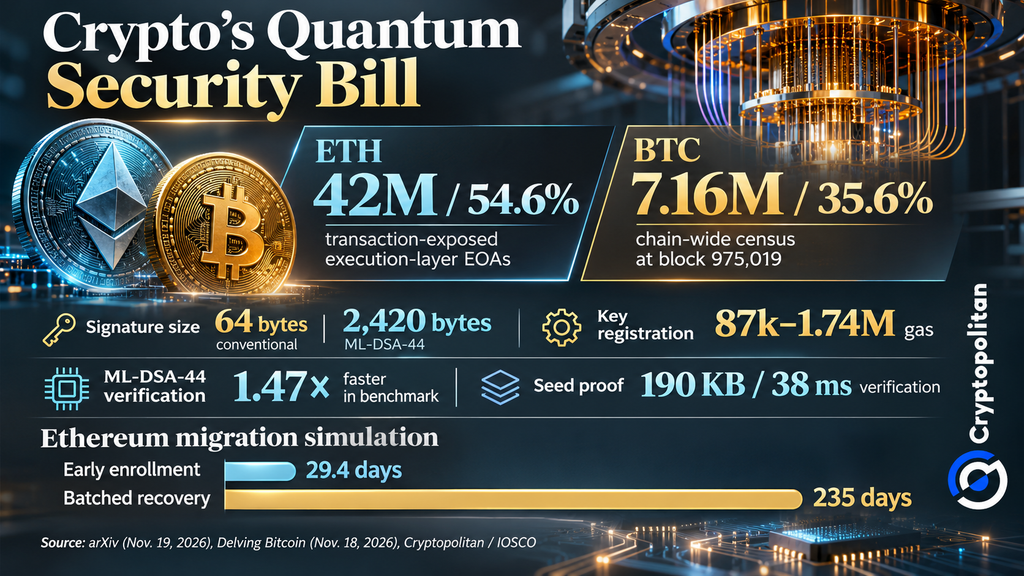
The Ethereum work looked at externally owned accounts, which are controlled by private keys rather than smart contracts. Accounts that had already revealed public keys through transactions held around 42 million ETH, described as 54.6 percent of the ETH on Ethereum’s execution layer.
A Bitcoin census published on 18 November examined the chain through block 975,019. It found about 7.16 million BTC sitting in transactions with exposed public keys or spending scripts, about 35.6 percent of unspent bitcoin. Separately, Glassnode reported that bitcoin it classed as vulnerable to future quantum attacks had risen from 6.04 million BTC in May to 7.12 million BTC on 10 November.
Ethereum’s proposed migration is still a proposal
With millions of ETH in accounts that have already revealed public keys, the Pittsburgh-led study looked at how those funds might move into quantum-resistant storage, and how fast that could happen if owners act. It proposed letting users register quantum-resistant keys before Ethereum retires the current signature scheme. Owners who missed that deadline could still try to recover an account by supplying cryptographic proof of ownership from the wallet recovery phrase.
The same study simulated a migration of 4.45 million accounts holding at least 0.1 ETH. If every owner registered early, the modeled migration took 29.4 days. If everyone instead used post-deadline recovery, it took 235 days. The binding limit was block space: each recovery proof was about 190 KB and took about 38 milliseconds to verify. Those timings are simulation results under stated assumptions, not a live network schedule.
Ethereum’s roadmap goal, as described in the reporting, is complete quantum resistance by December 2029. In a 19 November meeting, developers discussed shrinking the Hegotá upgrade as one way to move that work forward. That discussion is not the same thing as an activated rule.
For a holder, the trade-off in this proposal is timing versus proof size. Registering early keeps the migration inside a shorter window but still depends on the owner acting. Waiting pushes recovery into a much longer queue and still depends on the recovery phrase. A phrase backup has to stay confidential and redundant enough that the owner can produce it later; having one does not remove the risk of losing it, leaking it, or being unable to use it when a deadline arrives.

Bitcoin’s draft is narrower on purpose
Bitcoin, in the same reporting, was considering a slower path. Proposed BIP-360 would introduce Pay-to-Merkle-Root so that receiving bitcoin need not expose a public key. Spending could still reveal the public key. Shielding transactions while they wait for confirmation would need further changes to the signature system. None of that was described as an activated consensus rule.
Coinbase, which said it holds around 12 percent of bitcoin’s supply, suggested a gradual transition in which users could transact with either conventional or quantum-resistant signatures.
Where the bill shows up: size, capacity, and readiness
A conventional elliptic-curve signature is about 64 bytes. ML-DSA-44, a standardized quantum-resistant alternative cited in the reporting, is about 2,420 bytes. Larger signatures are not automatically slower to check. In one benchmark, ML-DSA-44 verification was 1.47 times faster than Ethereum’s conventional ECDSA verification.
Registration itself can be expensive in gas. Research tests on Ethereum recorded registration costs from 87,000 to 1.74 million gas units. On 19 November, the International Organization of Securities Commissions warned that larger signatures could cut network capacity and raise transaction fees. One experimental Solana testnet saw roughly a 90 percent drop in transaction-processing capacity; the reporting noted that this result does not necessarily describe Solana’s main network.
Institutional readiness was uneven in the same period. A November risk assessment by the European Banking Authority found that just 8 percent of surveyed banks had successful plans to move to quantum-resistant cryptography. For exchanges and custodians, the operational issue is not only upgrading systems. Moving large balances at the same time could raise settlement costs, and liquidity could suffer if sizable holdings were temporarily unreachable during a migration.
One check that stays inside what was reported
A practical distinction for long-term holders is whether an address has already signed. If it has, the public key may already be exposed in the sense these studies measured; if it has never signed, the address may still show only a hash. That check does not tell you whether a future quantum computer will exist on any particular date, and it does not make a wallet safe against every other failure. Proposals such as pre-deadline key registration, recovery-phrase proofs, BIP-360, and a dual-signature transition were still proposals in this November 2026 reporting, not rules already in force. Any later move still leaves ordinary custody risks intact: a recovery phrase that is lost, copied too widely, or unavailable when it is needed.