A balance kept on an exchange is accessible to that platform, so a court order served on the platform can stop a withdrawal even when the account holder is not the person the case names. In reporting published on November 24, 2026, some Binance users were described as facing that situation: the exchange could not release the funds, and support could not disclose the name of the case. One trader on X claimed that roughly 400,000 USDT was locked. That figure is the trader’s claim, not a loss confirmed in the report.
What the order required
On October 29, a Colorado judge signed a temporary restraining order targeting Huione Group and Xinbi, described as two Southeast Asian networks accused of laundering criminal proceeds. The U.S. Treasury said Huione laundered at least $4 billion between 2021 and 2025. TRM Labs said Xinbi processed over $24 billion, mostly in USDT on TRON. Those are the organizations’ stated figures about accused activity, not a report that a court had finished judging either network.
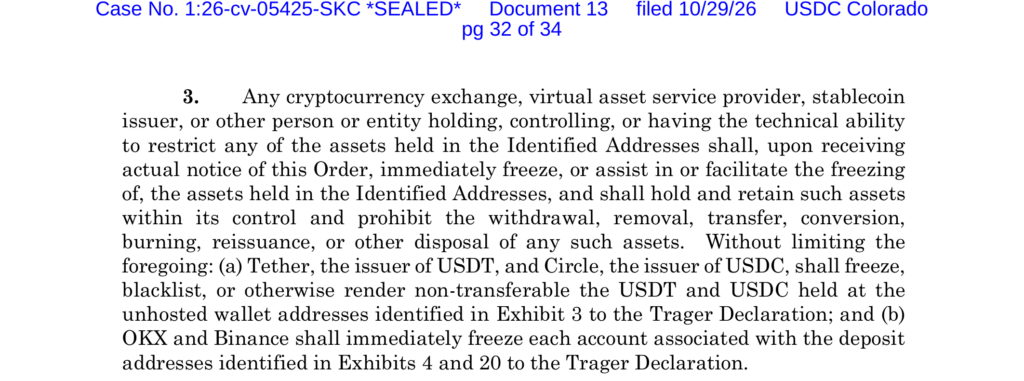
The order instructed Binance and OKX to freeze accounts linked to specified deposit addresses. Plaintiffs served notice to 27,304 TRON addresses. The reporting identified the practical problem with that kind of tracing: it can also capture funds belonging to unrelated individuals.
What the exchange said it could not do
Because the case was sealed, Binance support could initially refer only to a “Sealed Case Name.” On November 23, Binance acknowledged that unrelated accounts could be affected and that the exchange could not independently release their funds. The order remained in effect until November 27 unless extended. As stated in the November 24, 2026 report, affected users had until November 24 to contact the plaintiffs’ lawyers and raise objections. That deadline fell on the publication date itself.
The same day as its acknowledgment, Binance said on X that protecting users and complying with applicable legal obligations were both core responsibilities, and pointed readers to a blog on how court-ordered asset freezes work, why they may occur, what Binance can and cannot do, and what information may be available to affected users.
For a holder, the distinction in that account is between access and control. While the order stood, the exchange could custody the assets but could not release them on its own, and a sealed case limited what support could say. The report did not describe any step that would force an earlier release.

Faster freezes, slower courts
The report noted that, on the same night the Colorado judge signed the order, Binance itself became the victim of a major hack. It presented that overlap as timing, not as a stated cause. Tether blacklisted 971 million USDT within 57 minutes. According to Recoveris, issuers and protocols had frozen $2.84 billion within roughly 12 hours, before any court ruling. U.S. prosecutors later secured approval to seize $1.2 billion.
Separately, on November 18, Binance obtained a $6.5 billion worldwide freezing order from an Abu Dhabi court, covering approximately 26,000 wallets, including parties it does not accuse of wrongdoing. The report said these powers can help recover stolen money, and then asked what happens when someone with no involvement is caught in the process. It also noted that an English court had previously lifted a freezing order after the applicant failed to disclose that a wallet held pooled funds belonging to exchange customers. No date for that English ruling was given.
What the cited lawyers and investigators said
During a BeInCrypto Market Intelligence Expert Council discussion cited in the report, Erica Stanford, an adviser at law firm CMS, said there are legitimate uses for freezing crypto assets, and added: “what you also don’t want is a new version of fiat money where at their will governments can freeze money, can seize money, can stop you having money.” Patrick Prinz, co-founder of Recoveris, contrasted private-company freezes with law-enforcement practice and said, “I just wish there would be a clear seizing and freezing policy.”
The report’s closing observation was about speed, not about a particular portfolio. Crypto has made it possible to move and freeze billions of dollars within minutes, while the legal systems governing those assets still move more slowly. For an ordinary holder caught in a freezing order, that gap could mean weeks without access to money needed for living expenses, even when that person has committed no crime.
Nothing in the reporting treats an exchange balance, an issuer-controlled stablecoin, or a named wallet as free of restriction risk. It also does not say that any custody setup removes the chance of a court or issuer limit. The only holder action it specified, as of November 24, 2026, was contacting the plaintiffs’ lawyers to object, against an order scheduled to last until November 27 unless extended.