Anyone holding ether for the long run has to decide how much stays available and how much is handed to a staking arrangement run by someone else. Bitmine Immersion Technologies’ update, reported on November 24, 2026, shows how one public company has answered that for its own treasury.
The company acquired 7,819 ether in the last week, bringing reported holdings to 6.09 million ETH. Monday’s statement placed the exact figure at 6,085,564 ETH as of 3:00 p.m. ET on November 22. Bitmine said that equals 4.98% of a 122.2 million-token ether supply, and that it was 99% of the way to a goal it calls the “Alchemy of 5%,” 17 months after the pivot. The 5% level is still a stated target, not a completed holding.
Chairman Tom Lee said Bitmine has bought ETH each week since the Ethereum treasury strategy began on June 30, 2025. He also said no public company in the world has a buying record like the company’s. Earlier reporting had put the company around 187,000 tokens shy of the 5% mark.
Bitmine is described as the largest Ethereum reserve and the second-largest crypto reserve. Only Strategy Inc. is reported to hold more, with a reported 849,327 BTC worth about $52 billion. On June 26, 2026, Bitmine was added to the Russell 1000 large-cap index.
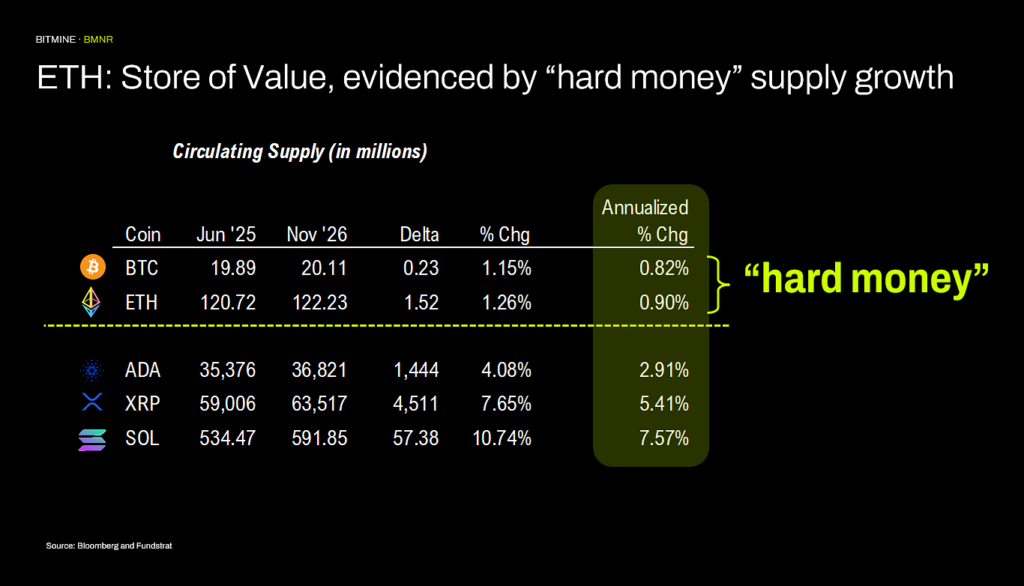
From the update, Lee constructed a supply comparison, not a forecast. He put ether supply growth at 0.90% annualized since June 30, 2025, or 1.26% in total, and Bitcoin’s annualized supply growth over the same period at 0.82%. “In other words, ETH and BTC have essentially the same inflation rate and both are ‘hard money’ measured in supply growth,” Lee said. He set annualized supply growth at 7.6% for Solana, 5.4% for XRP and 2.9% for Cardano, and said all three were far more inflationary. Those rates are his figures. Bitmine’s November 23 release included a chart of circulating supply growth for BTC, ETH, ADA, XRP and SOL from June 2025 to November 2026.
A chairman’s message on October 7 said a crypto bull market was underway and that this cycle was probably the biggest. That is the company’s characterization. Bitmine also equates the GENIUS Act and the SEC’s Project Crypto with the August 15, 1971 move that ended Bretton Woods and took the dollar off the gold standard. That is an analogy the company draws, not a change in how ether is issued or held.
The custody split is the part that changes access to the coins. Bitmine said it had staked 86% of its holdings, or 5,227,037 ETH, worth $9 billion at $1,726 per token. Staking is done through MAVAN, the Made in America Validator Network, which was built for Bitmine’s own treasury and is now accessible to custodians and institutional investors. The update does not describe key storage, recovery steps, or what happens if a validator fails. Staking most of a position can produce a stated yield while leaving a smaller share immediately available. It does not remove protocol, operator, or custody risk.
The company said the current stake generates $245 million a year at a 2.74% seven-day yield. Lee said that if Bitmine’s ether were fully staked, that would be $286 million. Both figures are tied to that snapshot, not a guaranteed rate. A practical check, using only what the company disclosed, is to separate the staked balance from the unstaked remainder, note who runs the validators, and treat the yield as a reported seven-day figure rather than a standing return.
Crypto, cash, securities and what Bitmine calls “moonshots” altogether were $11.1 billion. The pile includes $384 million in cash and marketable securities, 216 BTC, $180 million in Beast Industries and $54 million in Eightco Holdings. Other moonshots are held at a cost of $50 million.
At the time of the report, ether was trading at $1,726, up 0.8% in the past 24 hours. Bitmine shares were trading at $14.44, up 11.4% on the day. The update records those prices; it does not show why the shares moved.