For someone holding Bitcoin, a mining company’s move into AI raises a practical question: does less mining at one company mean less security for the network? Not necessarily. Bitcoin adjusts its mining difficulty as computing power enters or leaves, though the broader effect of miners shifting toward AI remains uncertain.
As reported on November 23, 2026, IREN and Hyperscale Data were taking different paths away from Bitcoin mining.
IREN’s revenue mix changes
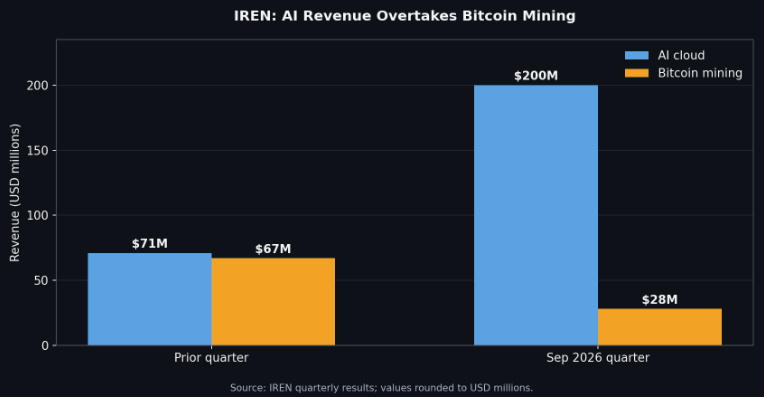
For the quarter ended September 30, IREN reported approximately $200 million in AI cloud revenue, up from $71 million in the previous quarter. Its Bitcoin mining revenue fell from approximately $67 million to $28 million. IREN also reported about 93 megawatts of operating AI cloud capacity at the end of September.

According to IREN’s SEC filing, management expected to substantially complete its move away from Bitcoin mining by December 31, 2026, with only immaterial mining operations continuing into 2027. That was a stated expectation, not a completed transition at the time of reporting.
Hyperscale sells BTC to help fund its transition
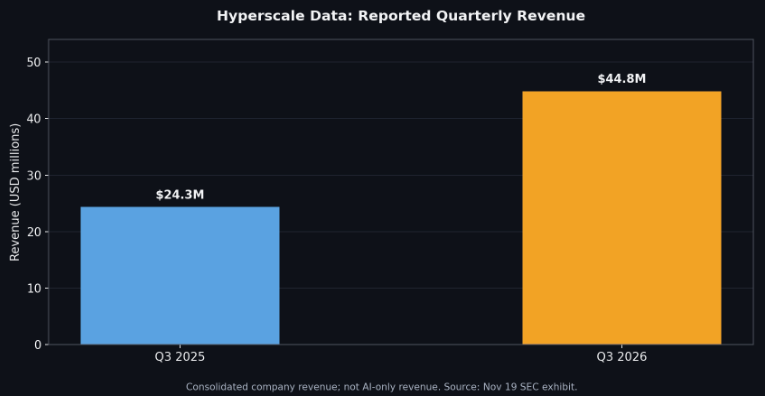
Hyperscale Data reported third-quarter revenue of $44.8 million, up 84% from the same period in 2025. It had stopped Bitcoin mining at its Michigan site on September 1 and planned to deploy 20 megawatts of AI computing capacity there: an initial 10 megawatts targeted for December 2026 and the rest expected by the end of March 2027.

In its November 19 financial announcement, Hyperscale said it had sold approximately 211.6 BTC for around $16 million in November. It said the proceeds went primarily toward debt repayment and its infrastructure transition. Building AI capacity still required substantial financing.

What a miner’s exit does—and does not—show
A company redirecting electricity away from mining does not, by itself, establish that Bitcoin’s total network hashrate has fallen. If substantial mining power does leave, Bitcoin’s difficulty adjusts approximately every 2,016 blocks to help maintain an average block interval of roughly ten minutes. Lower difficulty could improve conditions for remaining miners or encourage others to enter, but neither outcome is guaranteed.
Likewise, a miner’s BTC sale adds coins to the market without changing Bitcoin’s issuance schedule or 21 million-coin maximum supply. Whether the industry’s AI shift ultimately changes network hashrate depends on factors including electricity costs, mining profitability and whether other operators replace departing capacity.