A shutdown notice is most useful when you know where your assets are held and what action the deadline requires. In reporting published November 24, 2026, at 14:27 UTC+8, several crypto services faced different withdrawal, migration or redemption deadlines. Some routes remained available after an interface closed; others carried fees or offered no guaranteed recovery.
The approaching deadlines
Sophon set November 25 as its withdrawal deadline and November 30 for its mainnet shutdown. According to crypto.news, its bridge, node services and official front end were to be phased out starting November 25. The notice did not specify an exact cutoff hour or time zone, so the precise withdrawal deadline was unclear.
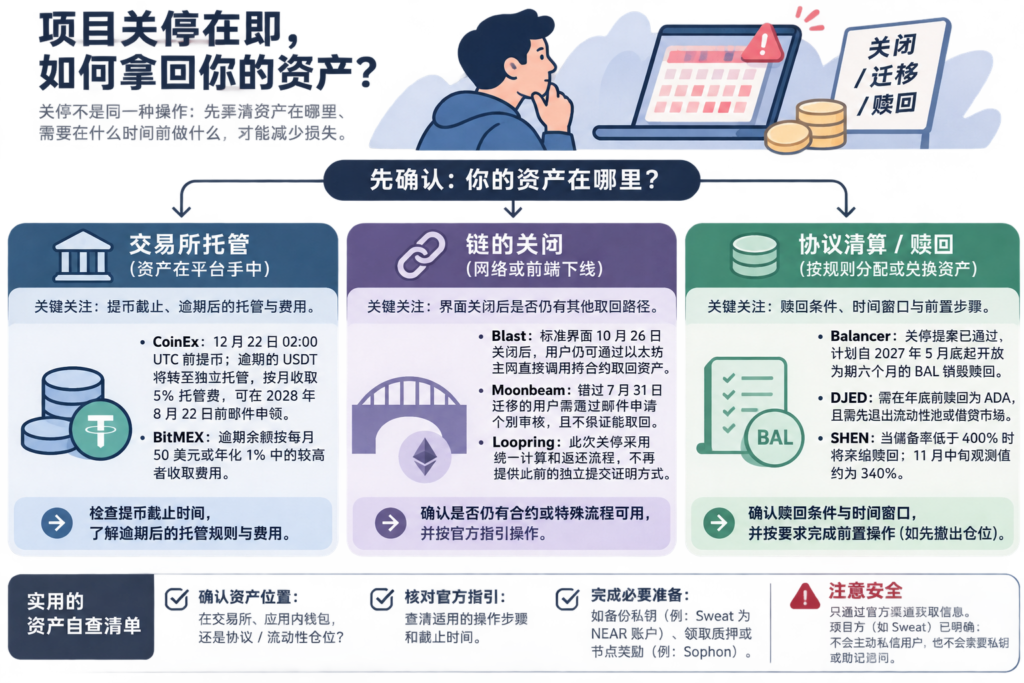
The reported December dates were December 15 for Abstract’s shutdown; December 18 as Sweat Wallet’s recommended date for users to complete their actions, ahead of the app and SWEAT token ending in their current form on December 30; and December 22 at 02:00 UTC for CoinEx withdrawals. DJED and SHEN services were set to stop on December 31 at 23:59 UTC. These dates described different services and should not be treated as interchangeable withdrawal deadlines.
What happens after a deadline?
On an exchange, custody and post-deadline fees matter. Under CoinEx’s reported rules, USDT left after December 22 would move to an independent custodian, with a monthly custody fee of 5%. Claims by email would remain possible until August 22, 2028. Arabian Post and other outlets reported that the fee was calculated against the balance at the cutoff. BitMEX’s reported charge on overdue balances was the higher of $50 per month or 1% annualized.
On a closing chain, the remaining recovery route matters. When Blast’s standard interface closed on October 26, approximately $40.4 million remained in its bridge, but users could still call the bridge contract on Ethereum directly. Moonbeam offered a less certain path: less than four hours before its July 31 migration deadline, only 24.83% of GLMR had passed through the migration contract. Those who missed the migration had to request individual review by email, with no guarantee of recovery. Loopring’s shutdown used a centrally calculated return process rather than the independent proof-submission route its system had previously offered.
In a protocol wind-down, redemption rules matter. Balancer’s shutdown proposal, BIP-928, passed with 99.2% support. Its plan would allow BAL holders to burn tokens for treasury assets beginning in late May 2027, during a six-month window. Former CEO Marcus Hardt estimated a value of about $0.158 per BAL; that calculation was unaudited. DJED holders were directed to redeem for ADA before year-end. SHEN redemptions freeze when the reserve ratio falls below 400%; the reported mid-November observation was around 340%.
Not every proposed change was already in force. Babylon co-founder Fisher Yu proposed ending Bitcoin staking before year-end and shifting resources to Trustless Bitcoin Vaults, but the proposal had not been put to a vote. Existing stakers would still face the original unstaking rules and time locks.
A practical custody check
First, identify whether an asset is on an exchange, in an app-controlled wallet, or committed to a protocol or liquidity position. The reported instructions differ: DJED holders were told to leave liquidity pools or lending markets before redeeming, while Sophon staking and node rewards needed to be claimed separately. For Sweat, each app account is a NEAR account, making access to its private key important once the app closes.
Use official channels to verify the applicable steps and cutoff. Sweat says it does not initiate private messages or ask for private keys or recovery phrases. A deadline is no reason to disclose either to someone offering to help.