For anyone relying on a smart contract to hold assets, the question is not just whether code has been reviewed, but which properties have actually been checked. An article published on November 11, 2026, describes an AI-assisted formal verification workflow that helps write those checks while leaving important limits in place.
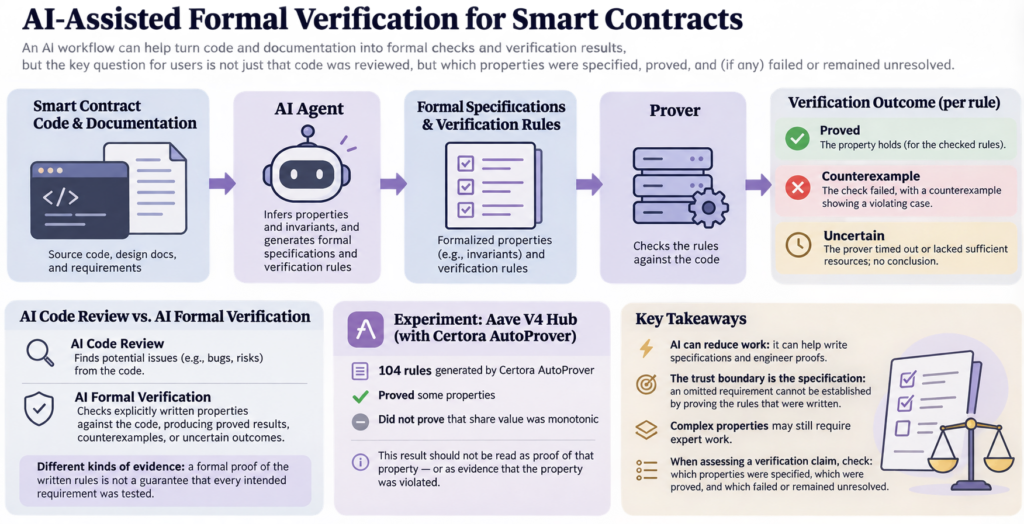
In the workflow, an AI agent infers properties and invariants from code and documentation, then generates formal specifications and verification rules. A prover checks the rules. If a check fails, it provides a counterexample; if it times out or lacks resources, the result remains uncertain. That is a different kind of evidence from an AI code review, but it is not a guarantee that every intended requirement was tested.
The article reports that, in an experiment on the Aave V4 Hub, Certora AutoProver generated 104 rules and proved some properties. It did not prove that share value was monotonic. The result should not be read as proof of that property—or as evidence that the property was violated.
AI may reduce the work of writing specifications and engineering proofs. The remaining trust boundary is the specification itself: an omitted requirement cannot be established by proving the rules that were written, and complex properties may still require expert work. For readers assessing a verification claim, the practical check is to look at which properties were specified, which were proved, and which failed or remained unresolved.