
If you rely on a wallet’s social login to recover access, it is worth asking what else must work—and who controls each part of that process. In an article published on November 10, 2026, at 14:04 (UTC+8), Liu Jiaolian reported that assets had been transferred from several thousand Keplr social-login accounts. Liu wrote that Keplr attributed the incident to a vulnerability in Web3Auth’s infrastructure. The detailed cause had not been disclosed, and the report did not establish a confirmed loss total.
Liu used the incident to compare four ways of holding or recovering wallet keys. The comparison describes trust boundaries; it does not establish how the Keplr incident happened.
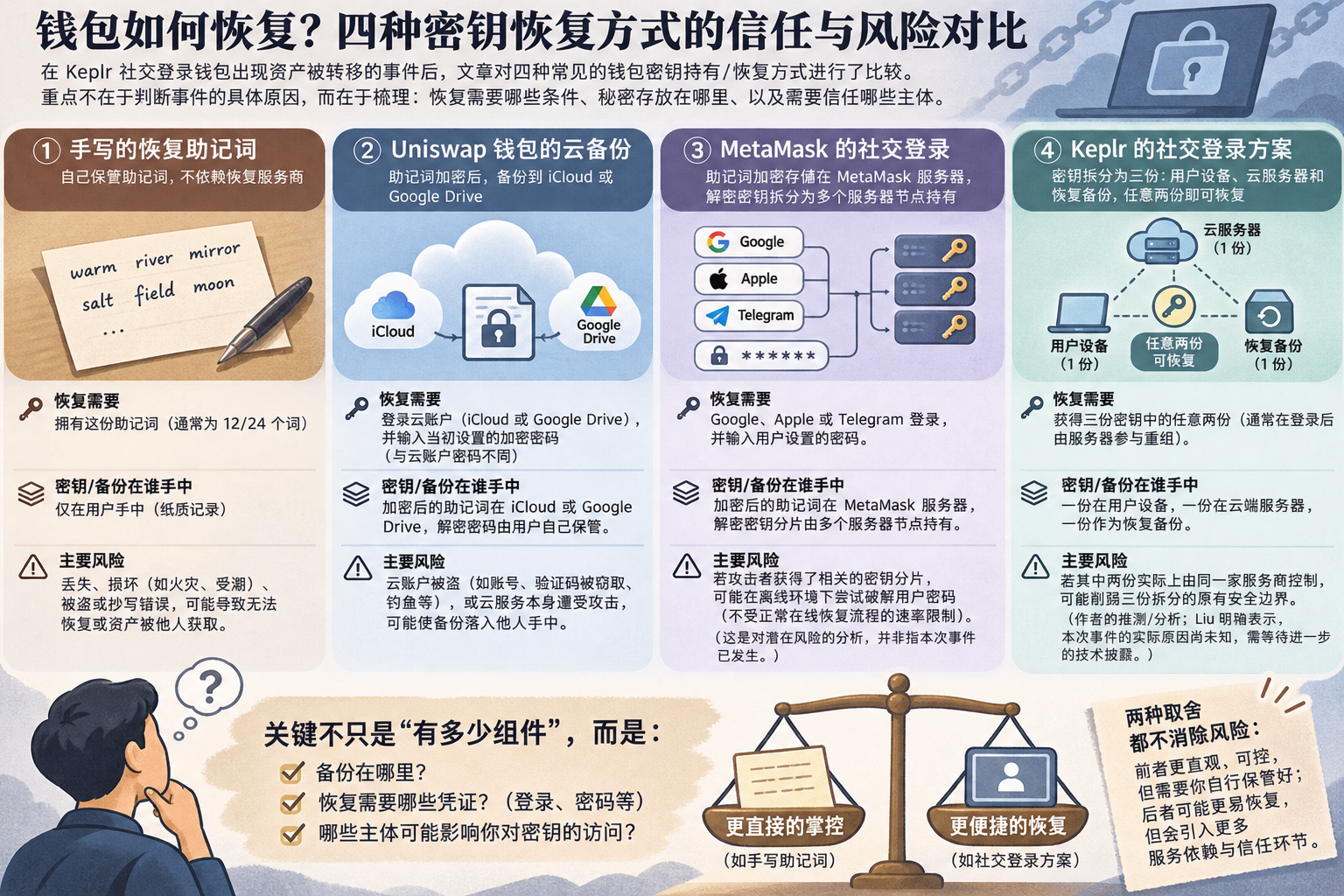
Four approaches to recovery
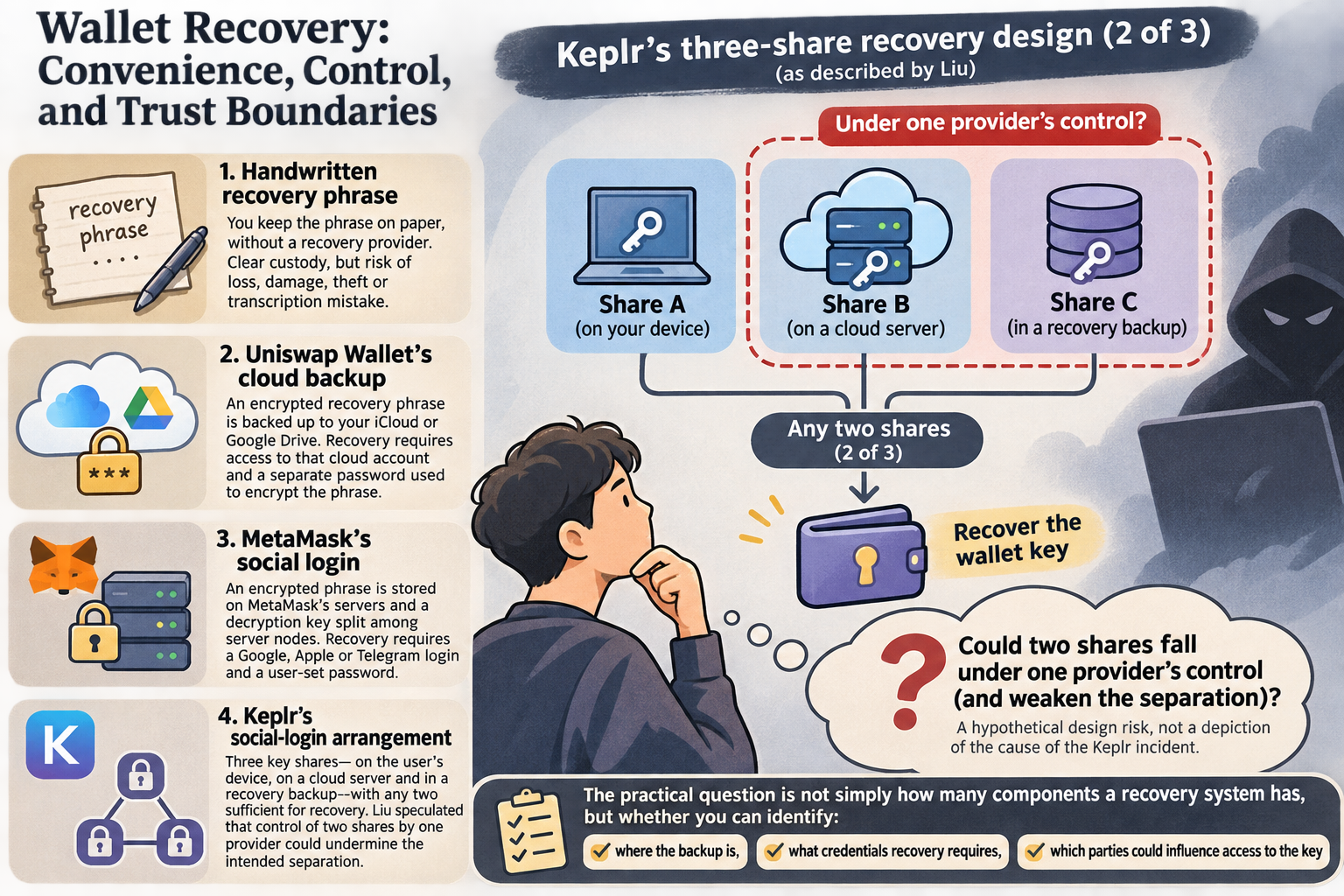
- A handwritten recovery phrase: The holder keeps the phrase on paper, without relying on a recovery provider. That makes the location of the secret clear, but loss, damage, theft or a transcription mistake can prevent recovery or expose the wallet.
- Uniswap Wallet’s cloud backup: In Liu’s description, an encrypted recovery phrase is backed up to the user’s iCloud or Google Drive. Recovery requires access to that cloud account and a separate password used to encrypt the phrase. Cloud-account security and the encryption password therefore serve different purposes.
- MetaMask’s social login: Liu described an encrypted phrase stored on MetaMask’s servers and a decryption key split among server nodes. Recovery requires a Google, Apple or Telegram login and a user-set password. Liu argued that if an attacker obtained the relevant key fragments, they could try passwords offline, beyond the rate limits of the normal online recovery process. That is an analysis of a potential failure mode, not a claim that it occurred here.
- Keplr’s social-login arrangement: Liu described three key shares—on the user’s device, on a cloud server and in a recovery backup—with any two sufficient for recovery. Liu speculated that control of two shares by one provider could undermine the intended separation. Liu explicitly said the actual cause of the incident remained unknown pending further technical disclosure.
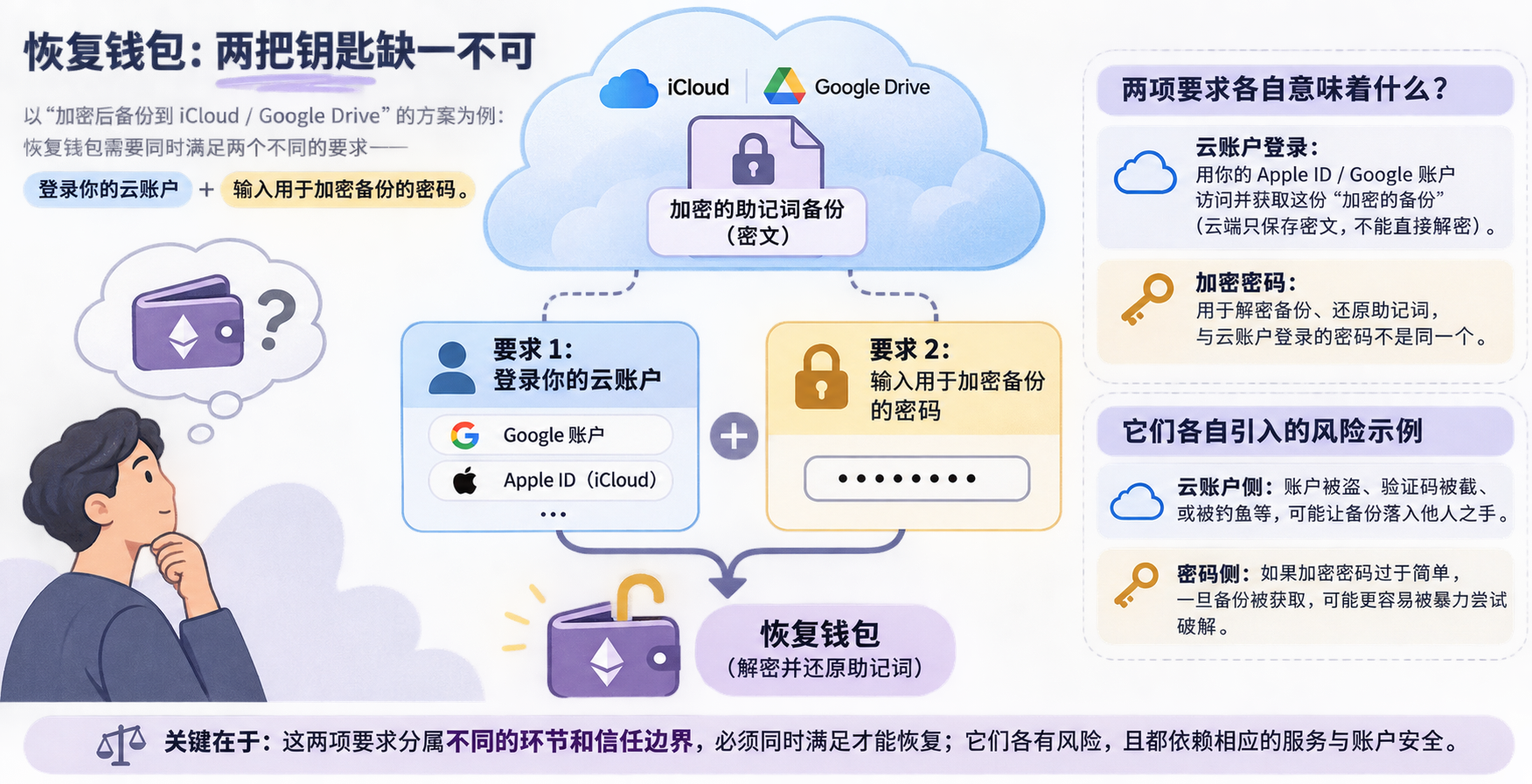
The practical question is not simply how many components a recovery system has. It is whether the holder can identify where the backup is, what credentials recovery requires, and which parties could influence access to the key. A paper phrase makes custody more direct but places the burden of keeping it accessible and confidential on its holder; a social-login option may ease recovery while adding service dependencies. Neither trade-off removes risk.
Source: techflowpost.com (originally published 2026-11-10 14:04 UTC+8)