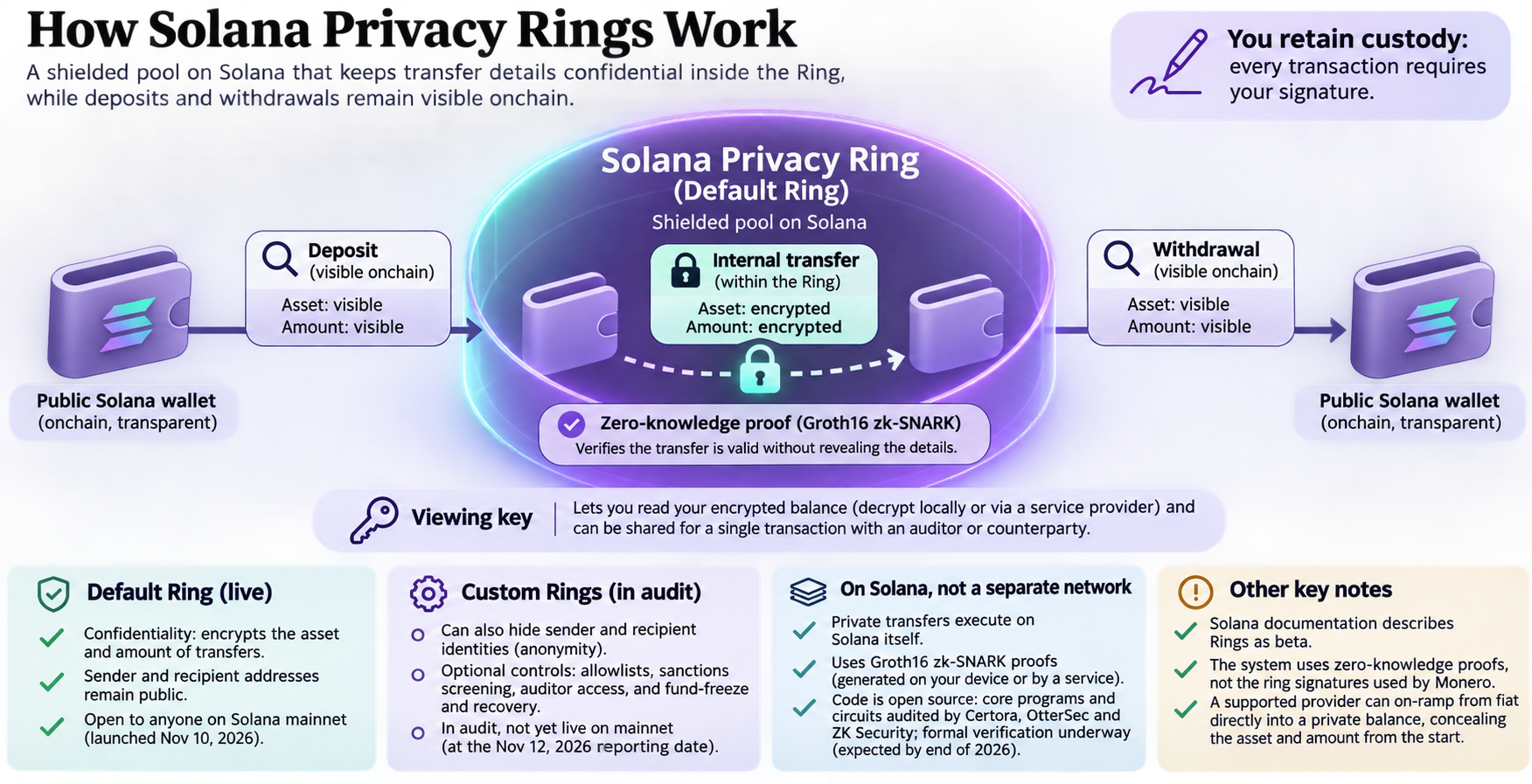
If you move funds into a Solana Privacy Ring, the first custody question is straightforward: do you still authorize transfers? According to the Solana Foundation, users retain custody and each transaction requires the owner’s signature. The privacy question is more nuanced. A Ring can conceal details of transfers inside it, but moving funds between a Ring and an ordinary public wallet remains visible onchain.
Helius launched Privacy Rings on Solana mainnet on November 10, 2026, as reported by Decrypt on November 12, 2026. This article describes the project’s status at that reporting date, not a later assessment.
What the live Ring hides
A Ring is a shielded pool on Solana. Users can deposit SOL or supported Solana tokens, transfer within the pool, and withdraw to a public balance. The live Default Ring provides confidentiality: it encrypts the asset and amount of a transfer, while sender and recipient addresses remain public. Deposits from and withdrawals to ordinary public wallets also reveal the asset and amount onchain. Helius says a supported provider can instead move funds from a fiat on-ramp directly into a private balance, concealing those details from the start.
Each private transfer includes a zero-knowledge proof so the network can check validity without seeing the protected figures. Helius says the system uses Groth16 zk-SNARK proofs, which can be generated on a user’s device or by a service provider. Transfers execute on Solana itself, rather than through a separate layer-2 network or sequencer.
For someone checking access to their own funds, another distinction matters: a viewing key lets its holder read encrypted balance information. Users can decrypt balances locally or have a service provider do so. They can also share access to a single transaction with an auditor or counterparty without revealing their entire history, according to the source.
Features still under review
Helius also describes Custom Rings for businesses and institutions. These can be configured to hide both amounts and the identities of senders and recipients, and operators can add controls such as allowlists, sanctions screening, auditor access, and fund-freeze and recovery capabilities. Unlike the Default Ring, Custom Rings were in audit, not yet live on mainnet, at the November 12 reporting date. The Solana Foundation expected them to reach mainnet in the following weeks; that was a forecast, not a confirmed launch.
Helius says Certora, OtterSec and ZK Security audited the core programs and zero-knowledge circuits. The code was open source, but formal verification was still underway and expected to finish by the end of 2026. Solana’s documentation described Rings as beta. Those are useful facts to weigh alongside the privacy claims; an audit is not a guarantee that a wallet or protocol has no risk.
The name can also mislead: Solana Privacy Rings use zero-knowledge proofs, not the ring signatures associated with Monero. For the live Default Ring, the practical distinction is simpler: transfer details can be confidential without the addresses or the public entry and exit points becoming anonymous.
Disclosure from the original report: Decrypt said it had partnered with Helius to offer confidential transfers through the Decrypt Money Account.
Source: decrypt.co (originally published 2026-11-12 01:09 UTC+8)