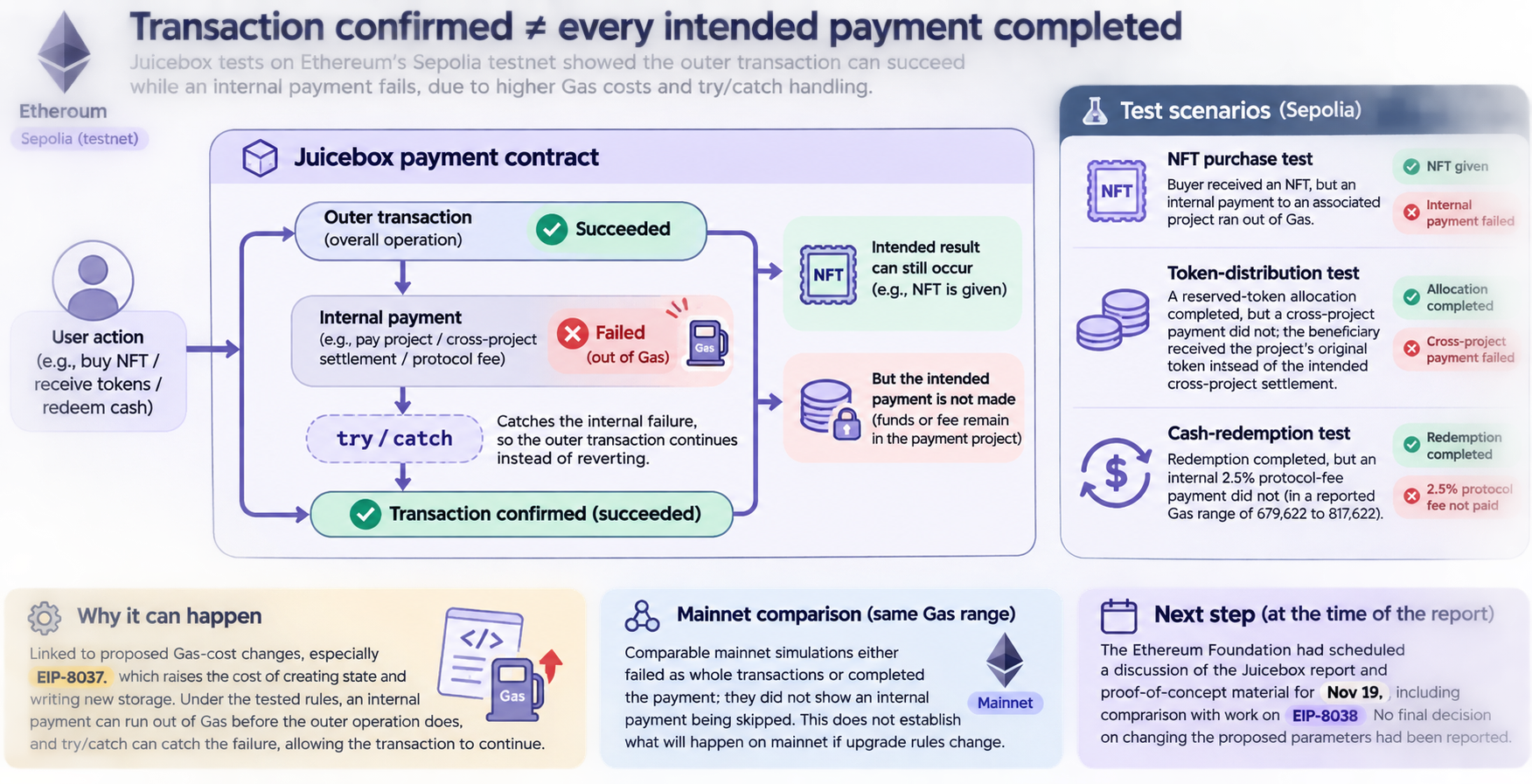
A confirmed transaction does not always mean every intended payment went through. In testing reported on November 17, 2026, simulations of Juicebox payment contracts on Ethereum’s Sepolia testnet showed transactions succeeding while internal payments failed. These were test results, not reported mainnet losses.
What the tests showed
According to Juicebox’s technical documentation, one NFT purchase test gave the buyer an NFT even though an internal payment to an associated project ran out of Gas. The unpaid amount remained in the payment project. In a separate token-distribution test, a reserved-token allocation completed, but a cross-project payment did not; the beneficiary received the project’s original token instead of the intended cross-project settlement.
A cash-redemption test found that, within a reported range of 679,622 to 817,622 Gas, redemption completed while an internal 2.5% protocol-fee payment did not. These outcomes matter because checking only the outer transaction’s success would miss the difference between the intended and actual fund flows.
Why the outer transaction could succeed
Juicebox developer mejango linked the behavior to proposed changes in Gas costs, particularly EIP-8037’s higher costs for creating state and writing new storage. Under the tested rules, an internal payment could run out of Gas before the outer operation did. A contract’s try/catch handling could then catch the internal failure, allowing the outer transaction to continue rather than revert.
The report says comparable mainnet simulations in the same Gas range either failed as whole transactions or completed the payment; they did not show an internal payment being skipped. That comparison does not establish what will happen on mainnet if upgrade rules change.
At the time of the November 17 report, the Ethereum Foundation had scheduled discussion of the Juicebox report and proof-of-concept material for November 19, including comparison with work on EIP-8038. No final decision on changing the proposed parameters had been reported. For anyone checking a contract interaction, the practical distinction illustrated by these tests is between transaction confirmation and completion of each intended internal transfer.