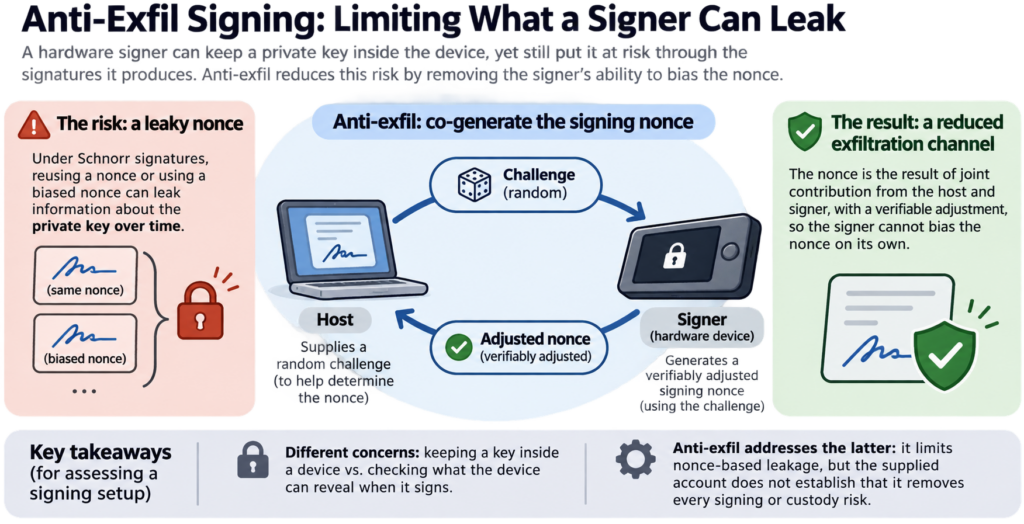
A hardware signer can keep a private key inside the device yet still put it at risk through the signatures it produces. In a Silicon Salon IV talk discussed in a transcript published on November 15, 2026, Andrew Poelstra examined how a signer could leak key information through its choice of signing nonce, and how an anti-exfil protocol aims to limit that channel.
Poelstra used Schnorr signatures to explain why nonce reuse and biased nonces matter. He also discussed the limitations of deterministic nonces, zero-knowledge proofs and multisignature approaches.
The approach he described has the host and signer contribute to the nonce without adding another long-term key for the user to manage. The host supplies a random challenge, and the signer produces a verifiably adjusted nonce. Poelstra presented this as a way to remove the signer’s ability to bias the nonce on its own. The talk also covered Blockstream Jade’s implementation, PSBT interaction and an earlier use involving OpenTimestamps.
For someone assessing a signing setup, the practical distinction is between keeping a key inside a device and checking what the device can reveal when it signs. Anti-exfil addresses the latter concern; the supplied account does not establish that it removes every signing or custody risk.