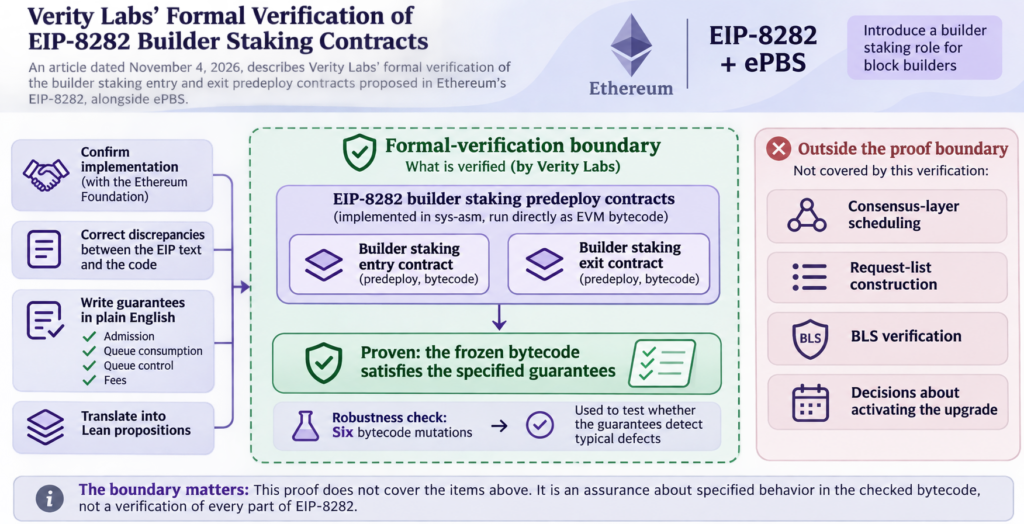
For long-term holders, a security proof is most useful when its limits are clear. An article dated November 4, 2026, describes Verity Labs’ formal verification of the builder staking entry and exit predeploy contracts proposed in Ethereum’s EIP-8282, alongside ePBS.
The two contracts are written in sys-asm and run directly as EVM bytecode. Verity Labs first confirmed the implementation to be checked with the Ethereum Foundation and corrected discrepancies between the EIP text and the code. The team then expressed guarantees covering admission, queue consumption, queue control and fees in plain English, translated them into Lean propositions, and proved that the frozen bytecode satisfies them. Six bytecode mutations were also used to test whether the guarantees would detect typical defects.
The boundary matters: this proof does not cover consensus-layer scheduling, request-list construction, BLS verification or decisions about activating the upgrade. It is an assurance about specified behavior in the checked bytecode, not a verification of every part of EIP-8282.