If you created a Qubic Wallet account with its built-in seed generator, the concern is not simply that the random numbers were weak. According to a SlowMist security analysis published on October 20, 2026, the wallet used the same non-cryptographic random stream for account seeds and for values that network participants could observe.
Qubic said in an October 18 announcement that an attacker had accessed 1,404 wallets and transferred approximately 2.94 trillion QU, exploiting insufficient randomness in some wallet seeds. SlowMist’s analysis describes a plausible route to recovering keys, but its local proof of concept does not establish that this was the method used in those transfers.
Where the trust boundary failed
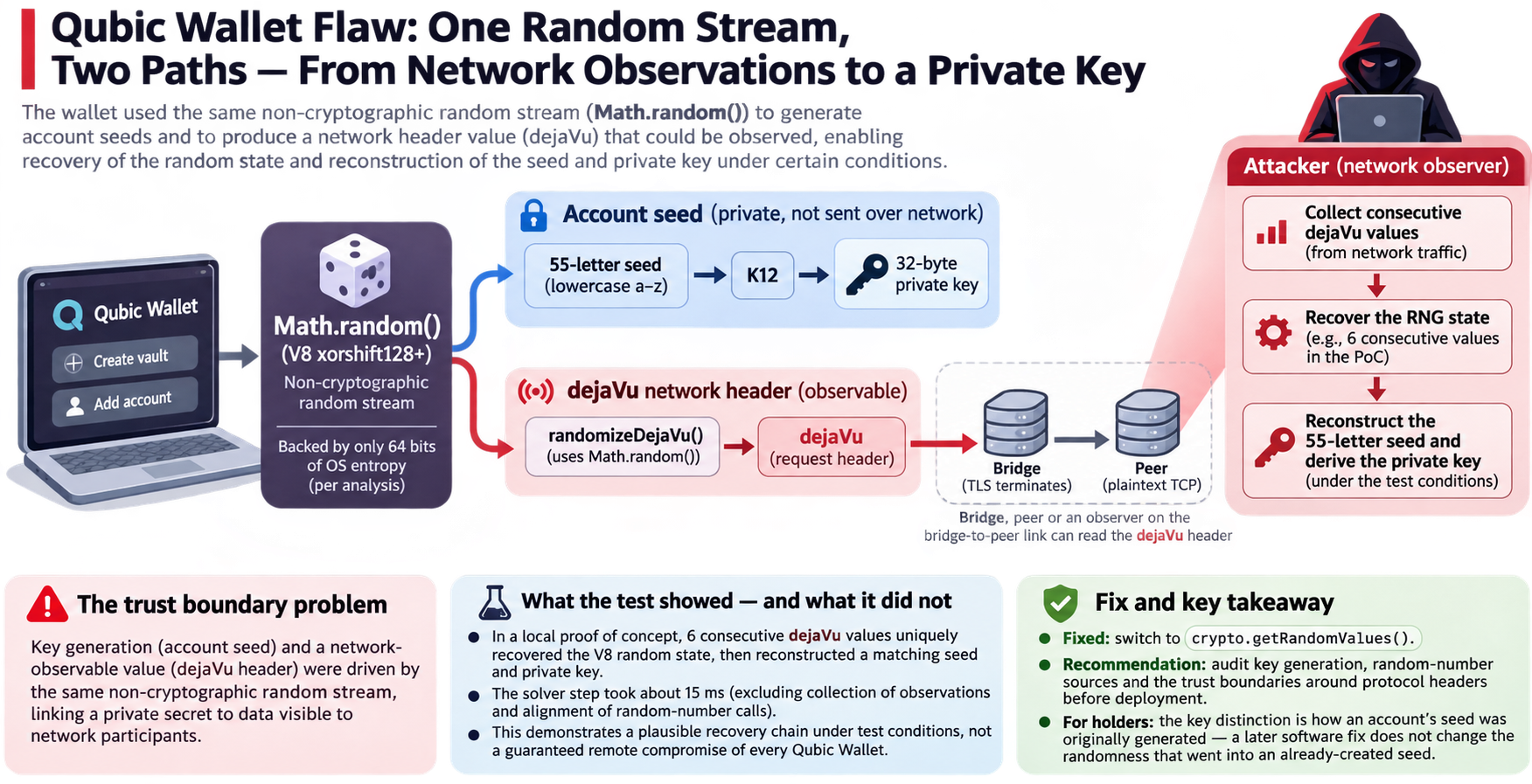
SlowMist found that Qubic Wallet’s “create vault” and “add account” functions generated a 55-letter seed using Math.random(). The wallet then deterministically converted that seed into a 32-byte private key using K12; no user password, device key or second random source was mixed into that derivation. Although 55 lowercase letters have a nominal space of about 258.5 bits, SlowMist said the wallet’s V8 random stream was ultimately derived from only 64 bits of operating-system entropy. Subsequent hashing could not add entropy that was absent at seed generation.
A separate function in @qubic-lib/qubic-ts-library, randomizeDejaVu(), also drew from Math.random(). It placed a truncated output in the dejaVu request-header field. SlowMist said the wallet connected to a bridge over TLS, after which raw Qubic packets were forwarded to a peer over plaintext TCP. That made the header values observable to the bridge, the peer or an observer on the bridge-to-peer link. Balance requests also carried a public key that could be used to check a candidate seed offline.
What the test showed—and what it did not
In a local proof of concept, SlowMist combined consecutive observed dejaVu values with a model of V8’s random-number generator. Four or five values left multiple possible internal states; six consecutive values uniquely recovered the state in its test. The team then reconstructed a matching 55-letter seed and private key. SlowMist said the solver step took about 15 milliseconds, excluding collection of observations and alignment of random-number calls.
That result demonstrates the proposed recovery chain under the test conditions, not a guaranteed remote compromise of every Qubic Wallet. SlowMist said real-world success would depend on where an attacker could observe traffic, whether the values were consecutive and correctly aligned, and whether other calls consumed numbers from the same random stream.
SlowMist listed the issue as fixed by switching to crypto.getRandomValues(). Its broader recommendation was for projects to audit key generation, random-number sources and the trust boundaries around protocol headers before deployment. For holders, the key distinction is how an account’s seed was originally generated: a later software fix does not change the randomness that went into an already-created seed.