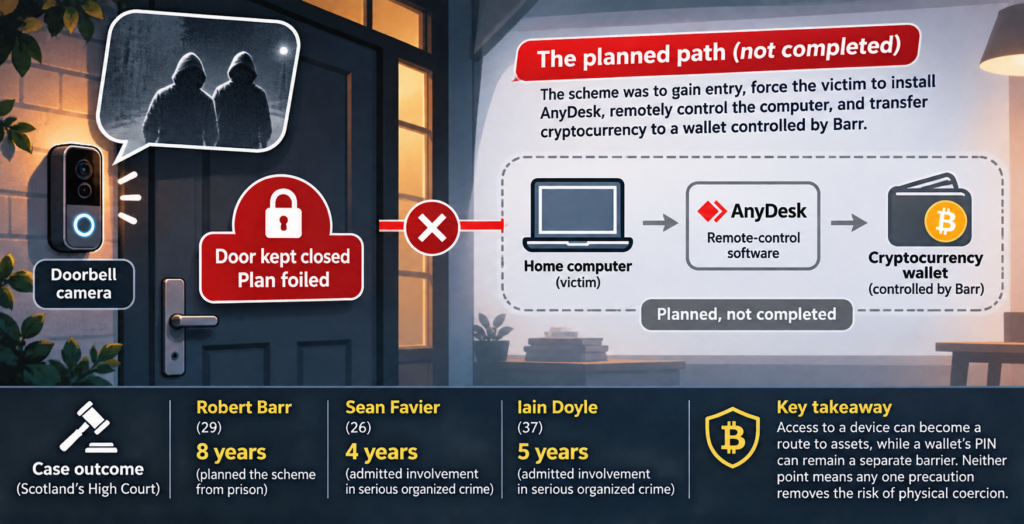
A doorbell camera helped stop a planned home intrusion aimed at gaining access to a victim’s computer and cryptocurrency, according to a ChainCatcher report published on November 11, 2026, at 18:25 (UTC+8). The reported figure of up to £2 million (about $2.7 million) was the amount targeted, not a confirmed loss.
Scotland’s High Court sentenced 29-year-old Robert Barr to eight years in prison. The court said Barr planned, while serving a 21-month fraud sentence at HMP Edinburgh, for Sean Favier and Iain Doyle to enter a home in Midlothian, near Edinburgh. They were to force the victim to install AnyDesk remote-control software, allowing Barr to control the computer and transfer cryptocurrency to a wallet he controlled.
Favier and Doyle arrived at about 11:30 p.m. on April 17, 2024. The homeowners saw them through a doorbell camera and refused to open the door, foiling the plan. Favier, 26, and Doyle, 37, admitted involvement in serious organized crime and received four- and five-year sentences, respectively.
Investigators recovered months of preparation from a phone seized from Barr in June 2024, including information about the intended victim, photographs of the house and messages explicitly mentioning threats or violence. The victim was a co-founder of a crypto startup. Barr’s associates had stolen a crypto wallet in a January 2024 break-in but could not access its funds without the PIN, the report said.
The prosecution called Barr a “sophisticated cybercriminal.” Judge Lord Cubie described the case as a combination of modern computer technology and old-fashioned burglary. As reported on November 11, the judge was due to consider a serious crime prevention order on November 17; Barr was also being held over a potential extradition. ChainCatcher cited a Chainalysis report estimating that more than $30 million had been stolen in such physical-coercion attacks during the first half of 2026.
The case illustrates a custody boundary: access to a device can become a route to assets, while a wallet’s PIN can remain a separate barrier. Neither point means any one precaution removes the risk of physical coercion.
Source: chaincatcher.com (originally published 2026-11-11 18:25 UTC+8)