By November 20, 2026, only 43.2% of Bitcoin’s supply was worth more than the price at which it last moved, down from 59.1% two weeks earlier. For holders trying to judge the extent of the selloff, the distinction is important: the measure counts coins, not people, and a transfer between wallets does not necessarily mean someone sold.
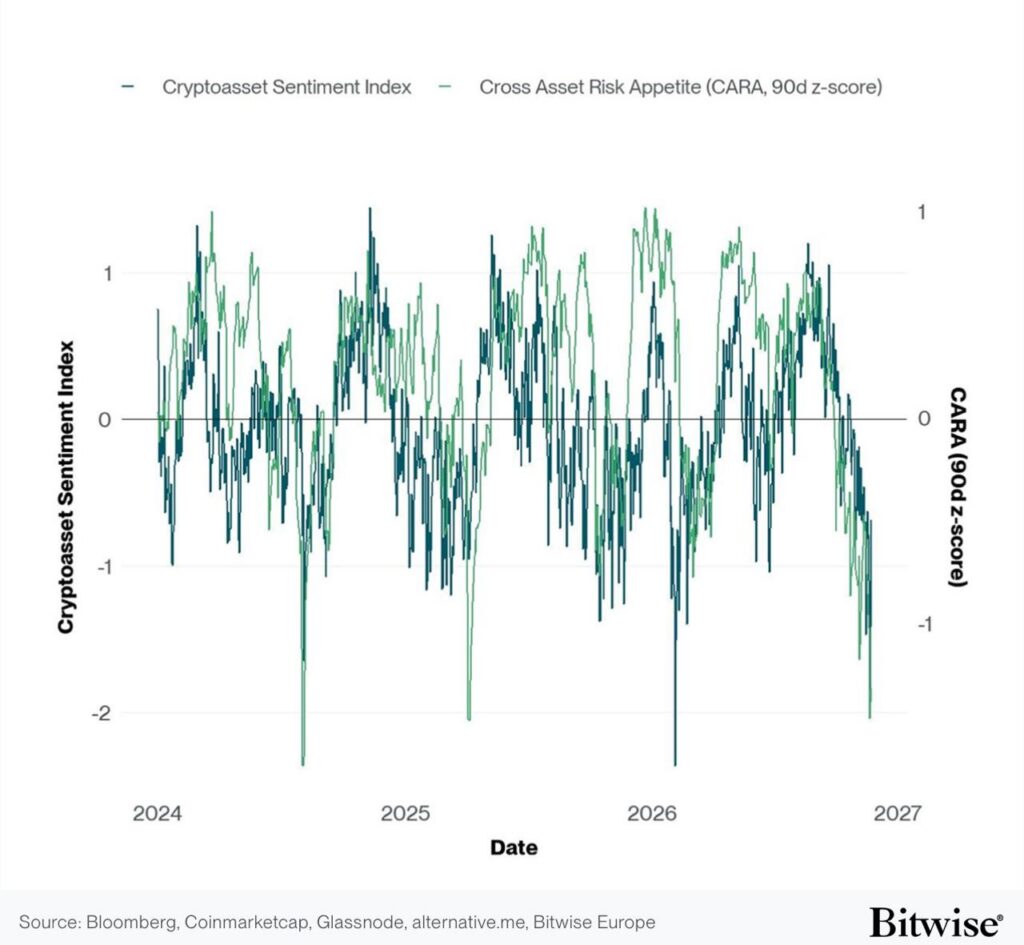
Bitwise’s Crypto Market Compass, published November 23, put its Cryptoasset Sentiment Index at 1.88 standard deviations below its usual level on November 20. That was its weakest reading since February and, by Bitwise’s count, one of the three lowest since FTX collapsed in November 2022. Both the sentiment and on-chain readings predated Bitcoin’s November 21 slide to $55,130.
Paper losses and coins changing hands
The share of Bitcoin supply in profit had been lower on only 99 of the preceding 5,970 days. Bitwise estimated that about $953 billion of invested capital was underwater, a level it compared with the FTX collapse. That figure describes capital held at a loss, not the amount lost.
Coins that moved below their previous on-chain price on November 20 accounted for $1.36 billion in realized losses by that measure. Only 18 earlier days had recorded more, and realized profit was about 15 cents for every dollar of realized loss. Yet the seven-day loss total of $5.3 billion remained below the roughly $5.7 billion recorded in November 2025 and the $9.1 billion recorded in February 2026. The data do not establish whether holders were reluctant to sell or whether more loss-taking lay ahead.
The November 21 low was Bitcoin’s weakest price since September 2024, below the late-June trough near $58,000. Bitcoin subsequently recovered to about $61,000. Bitwise tracked three reference points for that move:
- $64,300 — median realized price. Half of all coins last moved above approximately this price.
- $53,500 — realized price. The average price at which coins last moved was the closest of the three measures to the weekend low.
- $47,000 — long-term holders’ realized price. Bitwise identified this as a reference if Bitcoin fell below the overall realized price, but a decline that far was not its base case.

Traders paid unusually high premiums for protection
Only four of the sentiment index’s 15 indicators remained above their short-term trends. The separate Crypto Fear & Greed Index stayed in extreme-fear territory. More coins moved onto exchanges, which Bitwise saw as a sign of possible selling, though it did not report inflow volumes.
Two futures indicators improved: the share of leverage on the long side of Bitcoin futures and commercial traders’ net positioning on the CME. The latter group reduced its net short position from 11.11% to 7.28% of open interest. Bitwise interpreted the changes as evidence that leveraged long positions had already been forced out.
Perpetual futures open interest fell about 4.5% to roughly 439,000 BTC. Annualized funding dropped from 6.6% to about 1.7%, while the three-month futures premium narrowed from 5.2% to about 4.5%. Combined liquidations totaled about $4.9 billion.
Options open interest, by contrast, rose about 18.5% to roughly 548,100 BTC. The put-to-call ratio on crypto-native exchanges reached 0.83, near the 99.9th percentile of its three-year range. The premium traders paid for puts relative to comparable calls, measured by 25-delta skew, was at or above the 99th percentile at every maturity from one week to six months. Those prices showed strong demand for downside protection without establishing how many holders sold coins.

A selloff beyond crypto, but an uneven recovery
Bitcoin and the Nasdaq Composite each lost about 10% over the report week, while Ether fell 14%. The S&P 500 dropped 8.6%, Nvidia lost 22.9%, and TSMC fell 20.1% in its worst week since 2006. Gold and silver also declined, by 8.9% and 16%, respectively.
Bitwise’s cross-asset risk appetite gauge, which had fallen alongside crypto sentiment since September, moved from −0.51 to −1.11 after reaching −1.14 midweek. The firm compared those readings with the mid-2024 yen carry-trade unwind and the early-2025 tariff selloff. Equity options did not reach the same extremes: the VIX closed at 35.89 on November 20, its highest close of 2026 but below the 38.57 close in August 2024 and 52.33 in April 2025.
Bitwise attributed the broad decline to changing interest-rate expectations and discounted the Binance hack as a driver because it had occurred several weeks earlier. According to the firm, federal funds futures implied a 93% chance of a December rate increase and a 63% chance of two more increases by January 2027. Minutes from the October Fed meeting indicated that almost all officials expected further tightening. Governor Christopher Waller had raised the possibility of a half-percentage-point December move; no such decision had been made.
Bitwise’s measure of Fed officials’ public comments had returned to levels last seen in 2021. With the 10-year Treasury yielding 4.95% and the two-year yielding 4.66%, the firm judged that a large December hike would likely push the shorter yield above the longer one. Bitwise noted that such inversions have usually preceded pauses and later cuts, but the Fed had not signaled a pause.
On November 23, the Nasdaq rose 6.5% while Bitcoin gave back its intraday rally. Fund flows during the report week also showed weak demand: every major U.S. spot Bitcoin ETF in Bitwise’s data recorded net redemptions. Of the $1.84 billion in total net outflows, BlackRock’s IBIT accounted for $1.37 billion, or about three-quarters. Grayscale’s GBTC saw $119.3 million leave and Bitwise’s BITB recorded $43.6 million in net outflows. U.S. spot Ether ETFs lost a net $288.4 million.
Bitwise said similarly low sentiment readings had historically preceded strongly positive 12-month returns, but it supplied neither the number of observations nor the share of times that pattern held. The reading alone therefore says little about the likelihood of a recovery. More immediate evidence would come from whether ETF redemptions slowed, whether on-chain losses rose again if Bitcoin revisited its realized price, and what the Fed ultimately decided in December.