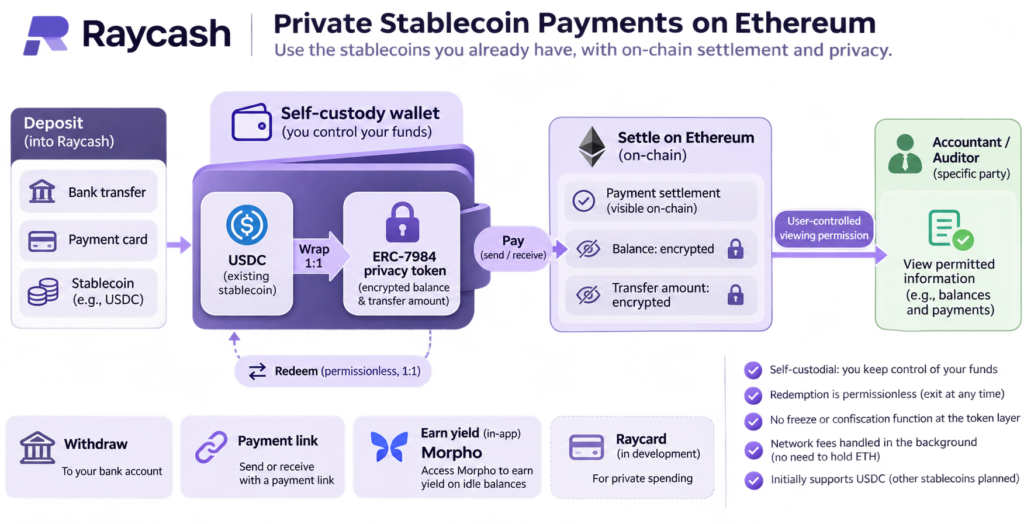
If you hold stablecoins in a self-custody wallet, Raycash’s pitch is a familiar trade-off: keeping control of your funds while limiting what others can see about your balance and payments. As reported on November 9, 2026, the Zama spinout had launched on Ethereum mainnet in an invite-only test, with a waiting list of more than 75,000 people, according to The Block as cited by TechFlow.
Raycash is the first retail payment product built on the Zama Protocol. Users can wrap existing stablecoins 1:1 as ERC-7984 privacy tokens. Payments still settle on-chain, but balances and transfer amounts remain encrypted rather than publicly visible. Raycash says redemption is permissionless, wallets are self-custodial, and the token layer has no freeze or confiscation function. Users can choose to grant specific parties, such as accountants or auditors, access to view their information.
The service initially supports USDC, with other stablecoins planned. It supports deposits by bank transfer, payment card or stablecoin, withdrawals to a bank account, and sending or receiving through payment links. Network fees are handled in the background, so users do not need to hold ETH. Raycash also offers access to Morpho within the app for users who want to earn yield on idle balances; a Raycard for private spending is still in development.
The launch follows other Zama privacy products. In June 2026, Zama, Morpho and Steakhouse Financial introduced a private USDC yield vault whose locked assets grew from zero to $40 million over seven weeks. On September 15, Zama expanded to 16 private vaults and launched private swaps on Ethereum.
Raycash co-founder and CEO Valerio Leo said users should not have to choose between stablecoin convenience and financial confidentiality. His stated approach is to make the stablecoins people already use private while allowing them to exit at any time.