For people holding crypto long term, a future quantum-resistant upgrade may not protect every wallet automatically. In reporting published on November 19, 2026, the International Organization of Securities Commissions (IOSCO) warned that dormant wallets and applications could remain exposed after a network upgrade if they still rely on older keys.
IOSCO said some quantum-resistant signatures are much larger than those used to authorize transactions today. If fewer transactions fit in each block, networks could face more congestion, higher fees and greater storage needs. It cited an experiment in which a test version of Solana ran about 90% slower with quantum-resistant signatures. That test is not a measure of how every network would perform.
The transition also crosses several security boundaries. Layer-1 networks use cryptography both to authorize transactions and to agree on new blocks. Layer-2 networks might adopt quantum-resistant proofs for transaction verification while still depending on vulnerable systems for settlement, transfers between chains or upgrade approvals.
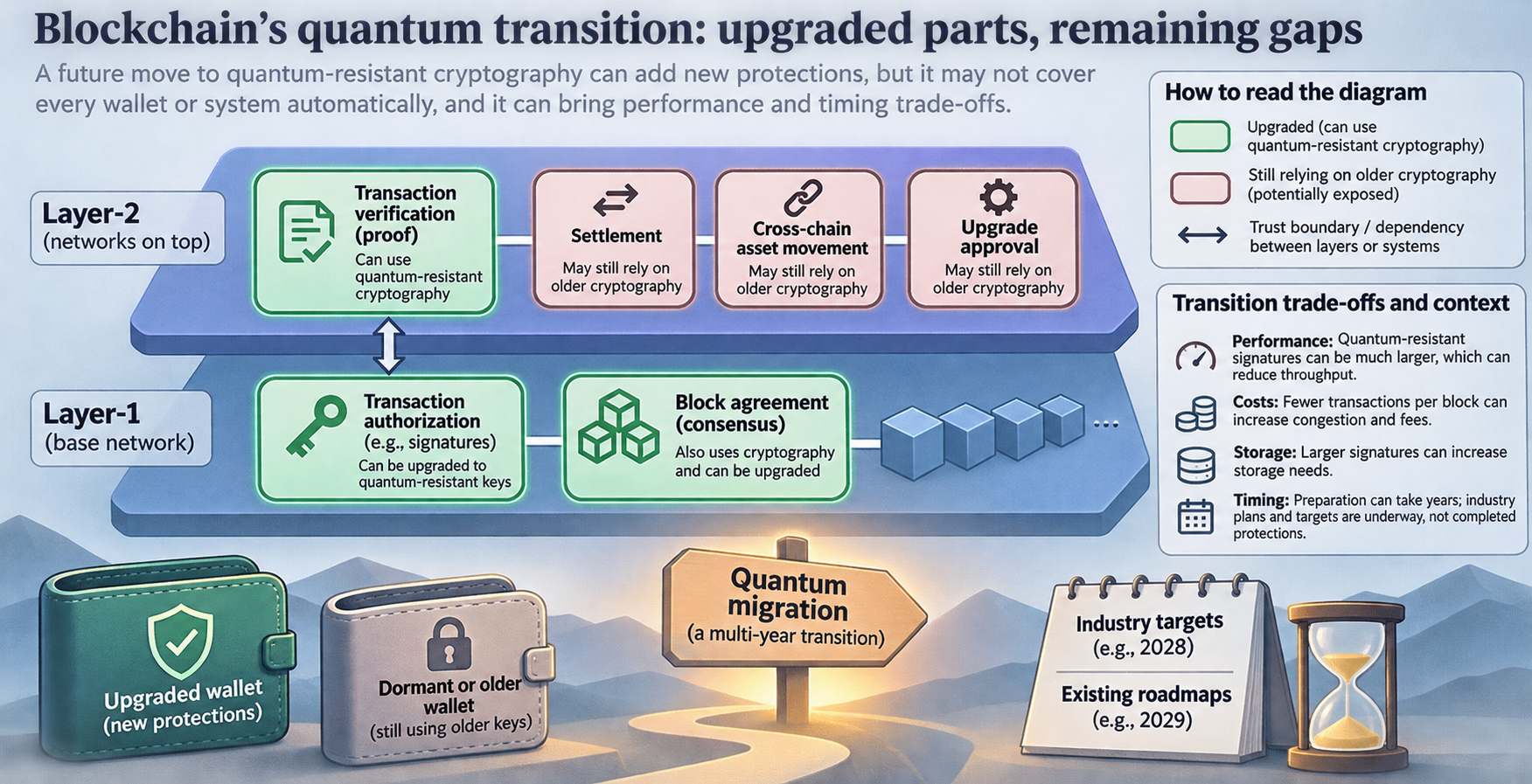
No known quantum computer can break the cryptography securing these networks today. IOSCO nevertheless urged firms to prepare because a transition could take years. The report’s practical distinction for holders is between a network adopting new protections and an older key actually being replaced; the source does not set out a wallet-migration procedure.
The performance and timing trade-offs were already part of industry discussion. Bitcoin advocate Samson Mow warned in April that larger post-quantum signatures could reduce Bitcoin’s throughput and that rushed fixes might introduce new vulnerabilities. In October, Starknet’s community backed research into becoming an independent, quantum-resistant layer-1 network amid concerns about its reliance on Ethereum’s upgrade timeline. Ethereum researcher Justin Drake subsequently outlined a 2028 post-quantum transition target, ahead of the network’s existing 2029 roadmap. These are warnings, research plans and targets—not completed protections.