A network upgrade can affect contracts people rely on, even when it is designed to make Ethereum more efficient. As reported on November 20, 2026, Ethereum developers had not decided whether to change the planned Glamsterdam hard fork to reduce potential compatibility risks—or keep its existing specifications.
Glamsterdam is intended to increase network capacity and efficiency. In October, blockchain security firm ChainSecurity warned that proposed gas-pricing changes could disrupt existing smart contracts and potentially expose them to exploitation. Developers subsequently postponed the Hoodi testnet fork, which had been scheduled for October 26. The concerns center on proposals EIP-8037 and EIP-8038.
Researchers identified 13 real-world examples of potentially affected contracts in October. A November investigation then examined eight smart contract invariants that the upgrade could disrupt. At the November 19 All Core Developers meeting, developers said the Ethereum Foundation, ChainSecurity and security firm Dedaub had collectively contacted at least 50 affected companies. Three projects were classified as high impact, with fixes completed or expected by mid-December; medium-impact projects reported timelines extending to January 10.
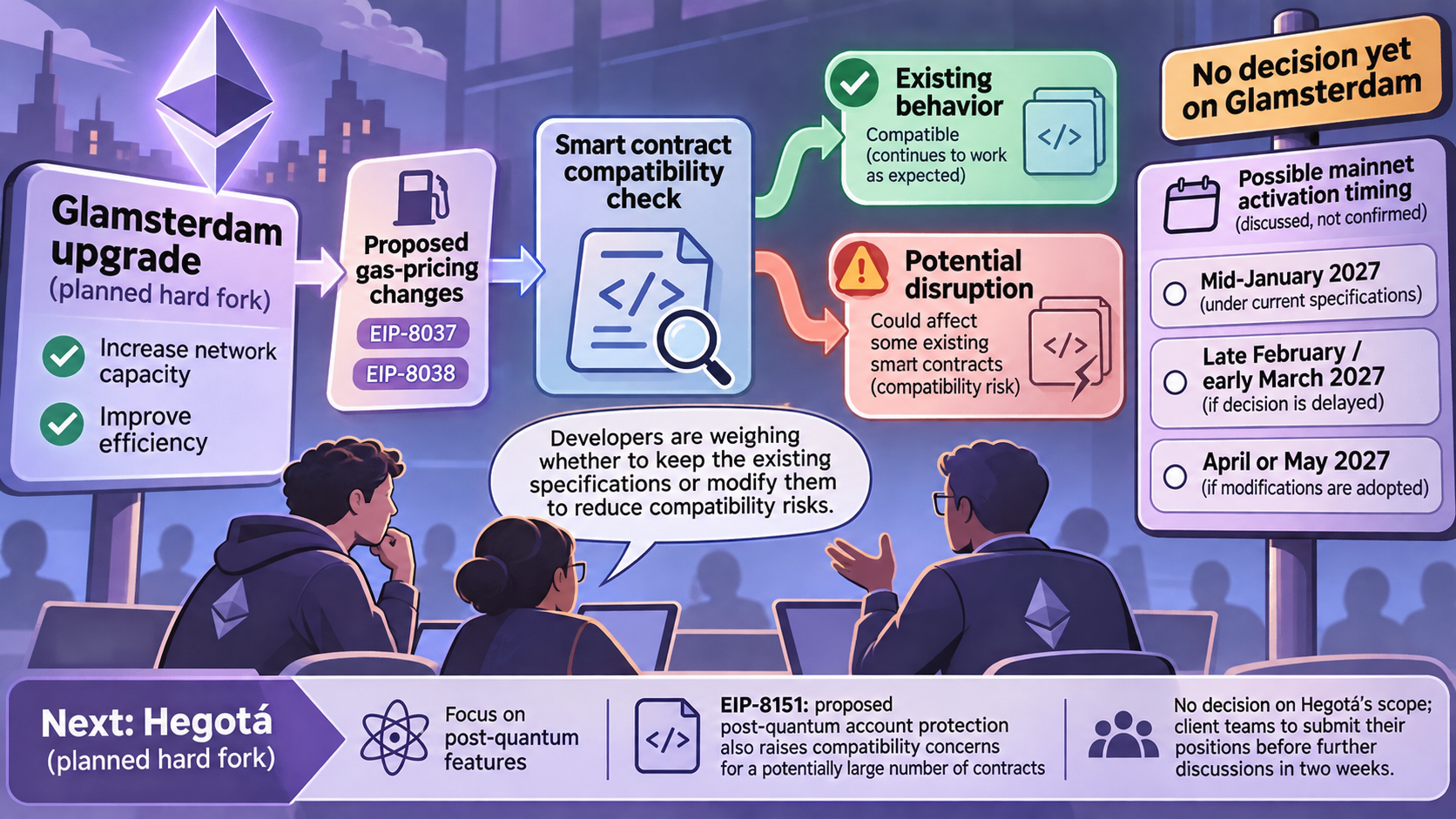
Developers face a trade-off: changing the specifications to protect some contracts could disrupt others. Under the existing specifications, mainnet activation could occur as early as mid-January 2027. Developers said waiting until January to decide could shift activation to late February or early March, or to April or May if modifications are adopted. Those dates were possibilities discussed at the meeting, not an agreed schedule.
Separately, developers discussed narrowing the scope of the subsequent planned hard fork, Hegotá, to prioritize post-quantum features. They also raised compatibility concerns about EIP-8151, a proposal intended to protect accounts migrating to post-quantum security. A preliminary review found that it could affect a potentially large number of existing smart contracts. No decision was reached on Hegotá’s scope; client teams were expected to submit their positions before further discussions in two weeks.