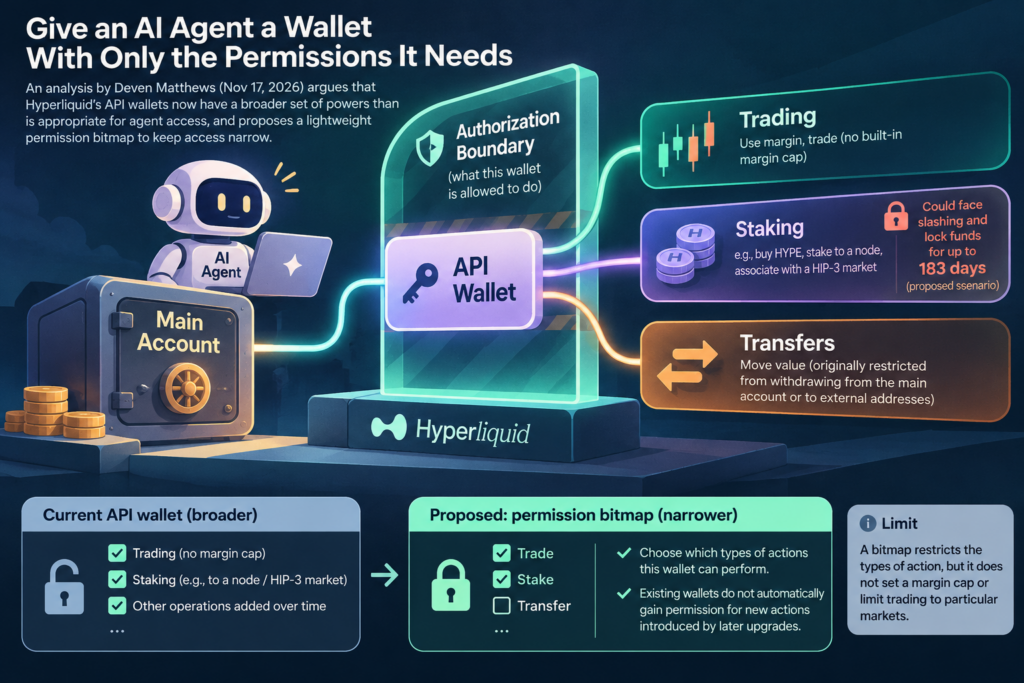
A wallet given to an AI agent should have only the authority it needs. In an analysis published on November 17, 2026, Deven Matthews argued that Hyperliquid’s API wallets no longer provide a sufficiently narrow boundary for that kind of access. The article describes potential ways a compromised wallet or manipulated agent could harm a main account; it does not report a confirmed loss.
Where the boundary can fail
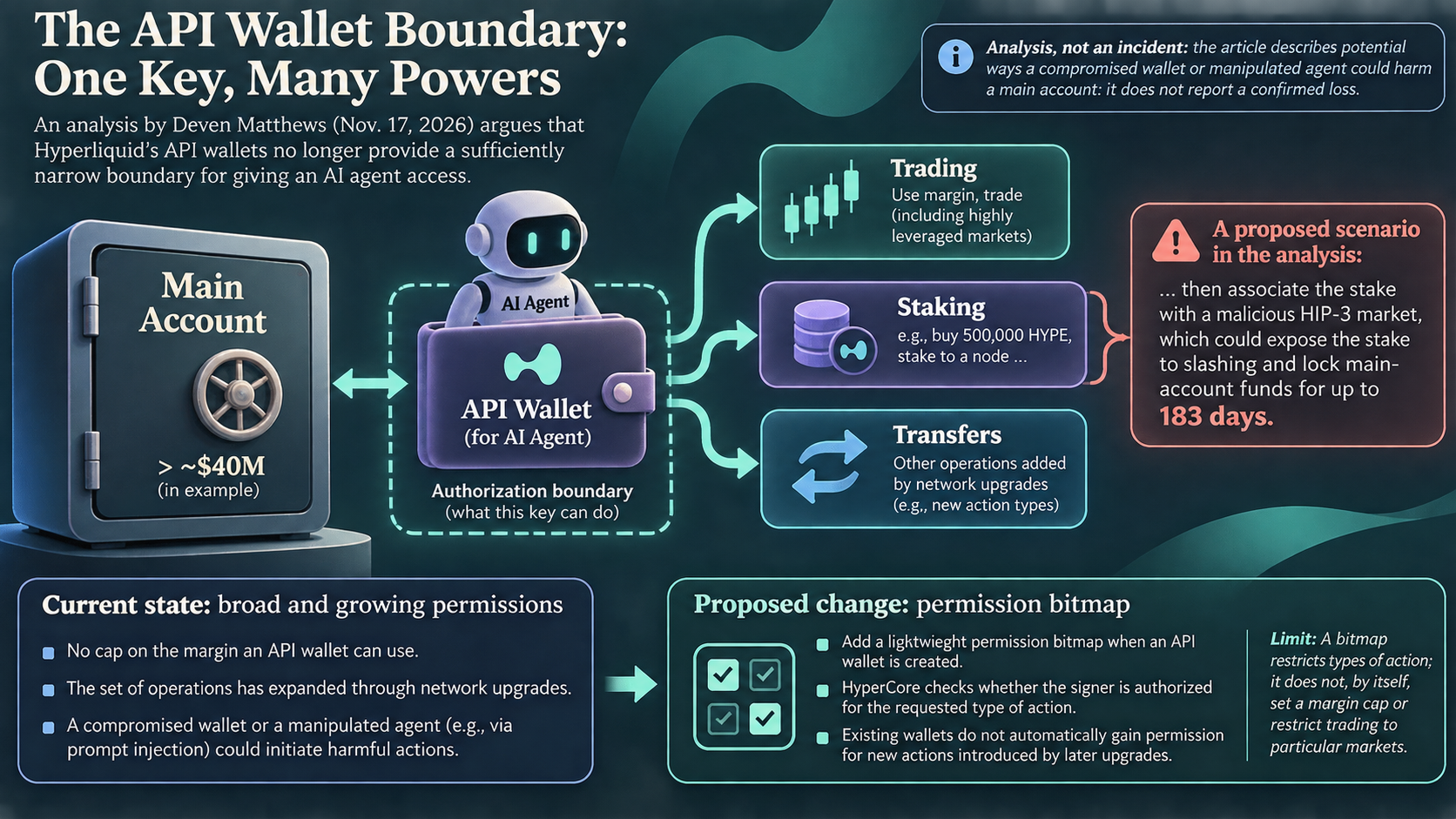
API wallets were originally restricted from withdrawing directly from a main account or transferring to external addresses. Matthews notes, however, that they had no cap on the margin they could use. In his assessment, a compromised API wallet could therefore move value through matched trades in a thin, highly leveraged market. He argues that subsequent network upgrades added other operations to API wallets without giving users a way to limit each wallet to specific actions.
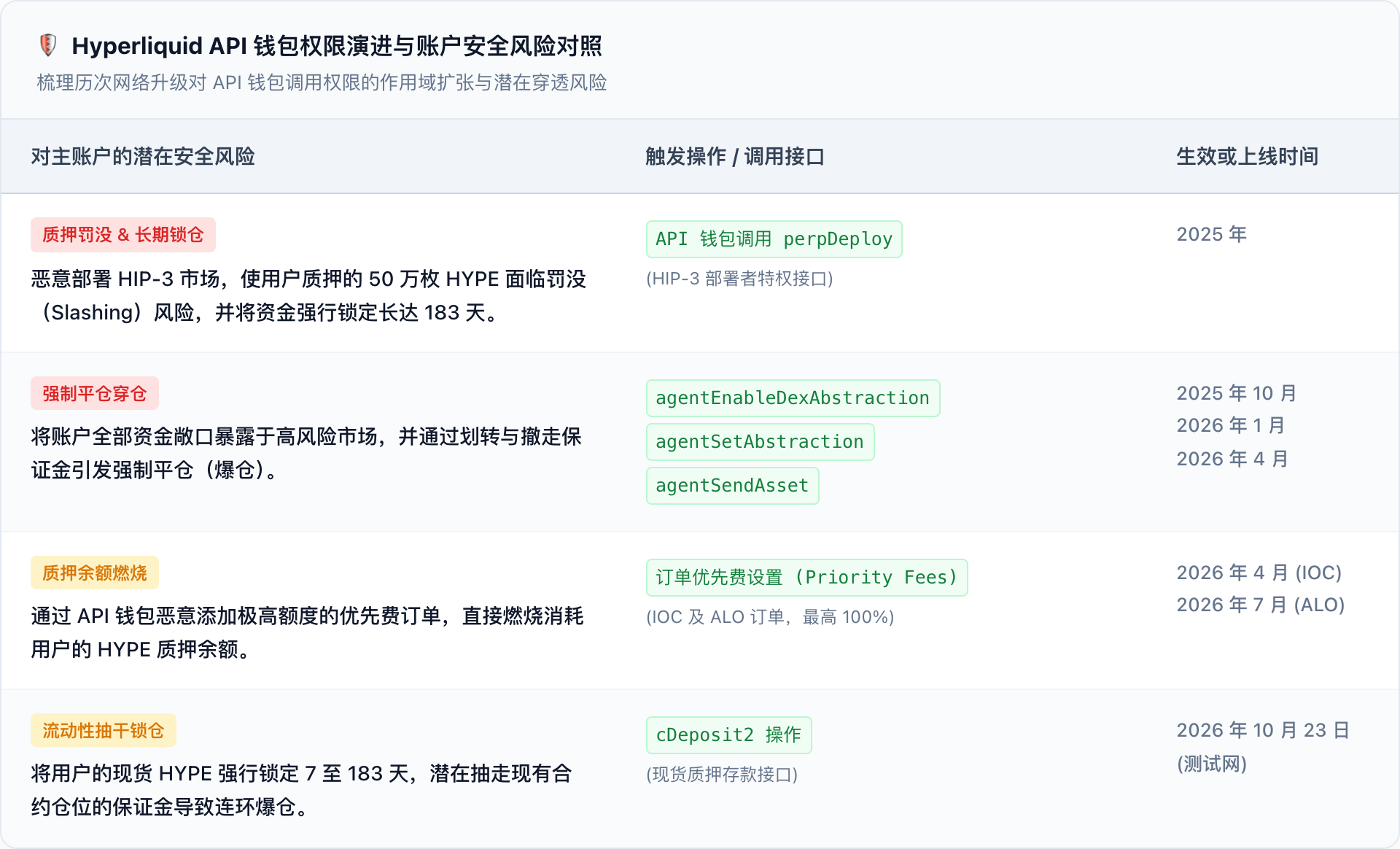
One scenario in the analysis involves a main account holding more than approximately $40 million. Matthews says a maliciously controlled API wallet could buy 500,000 HYPE, stake it to a node, then associate the stake with a malicious HIP-3 market. He warns that this could expose the stake to slashing and lock main-account funds for up to 183 days. This is a proposed attack path, not an account of an attack that occurred.
The concern extends beyond stolen keys. An agent interacting with untrusted online material could encounter a prompt-injection attempt and initiate harmful actions itself, Matthews argues. API wallets are also used for trading through Hyperliquid’s interface and are generated by many third-party applications and mobile wallets, according to the analysis.
The proposed change—and its limit
Matthews says HyperEVM smart-contract accounts can check transfers and multisignature thresholds, but routing frequent trades through Solidity checks before they reach HyperCore adds latency. Direct API-wallet access avoids that delay while retaining the broader permissions he identifies. Signing services that check policies locally instead place that trust in a centralized intermediary.
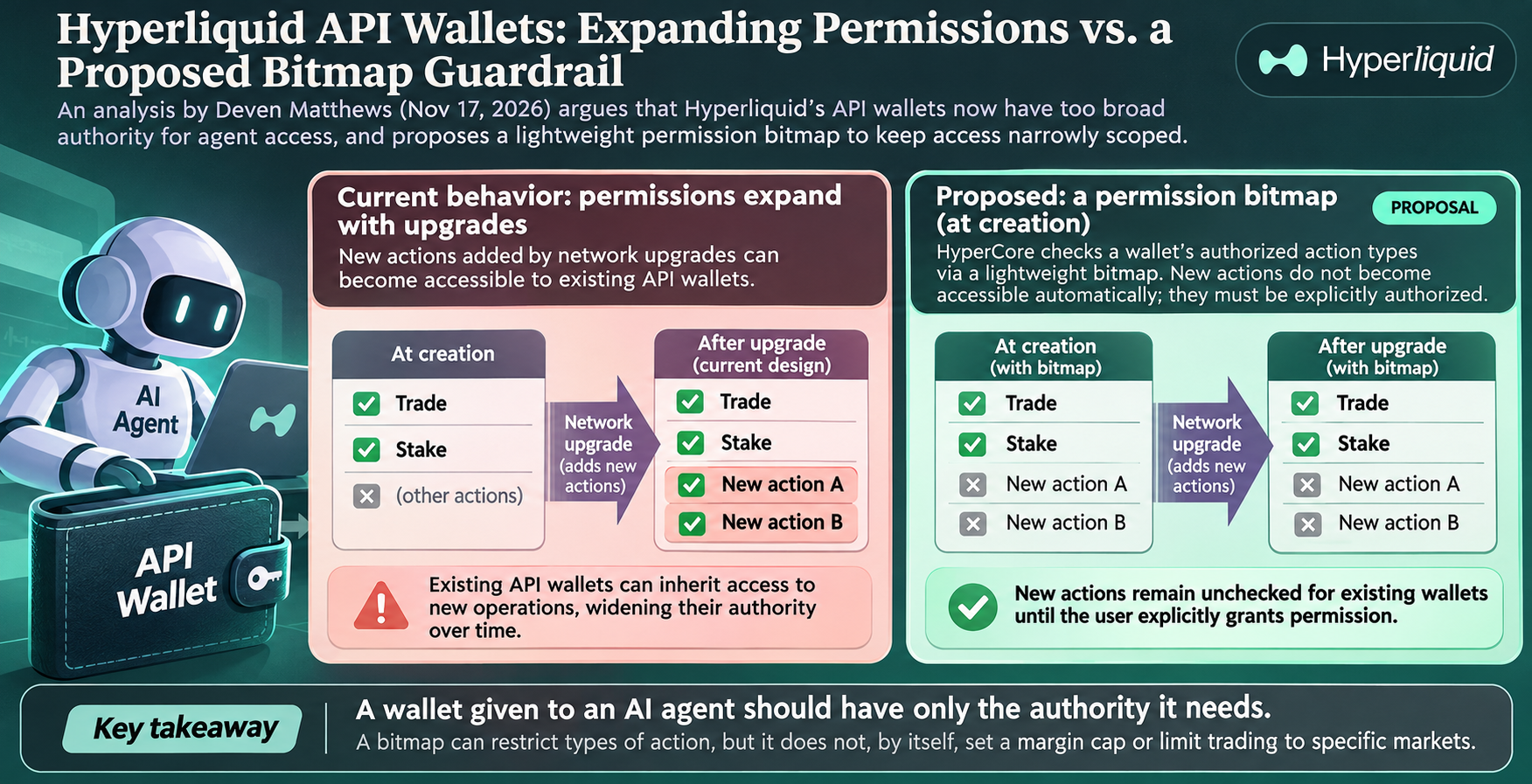
His proposal is to add a lightweight permission bitmap when an API wallet is created. HyperCore would check whether the signer is authorized for the requested type of action. Crucially, an existing wallet would not automatically gain permission for new actions introduced by later upgrades. Matthews points to restricted rights for HIP-3 sub-deployers as a precedent for the design.
A bitmap restricting types of action would not, by itself, set a margin cap or restrict trading to particular markets; the analysis presents those fuller controls as more demanding alternatives. For a holder considering agent access, the immediate question raised by the article is what an API wallet can actually authorize—not merely whether its key can be kept secret.