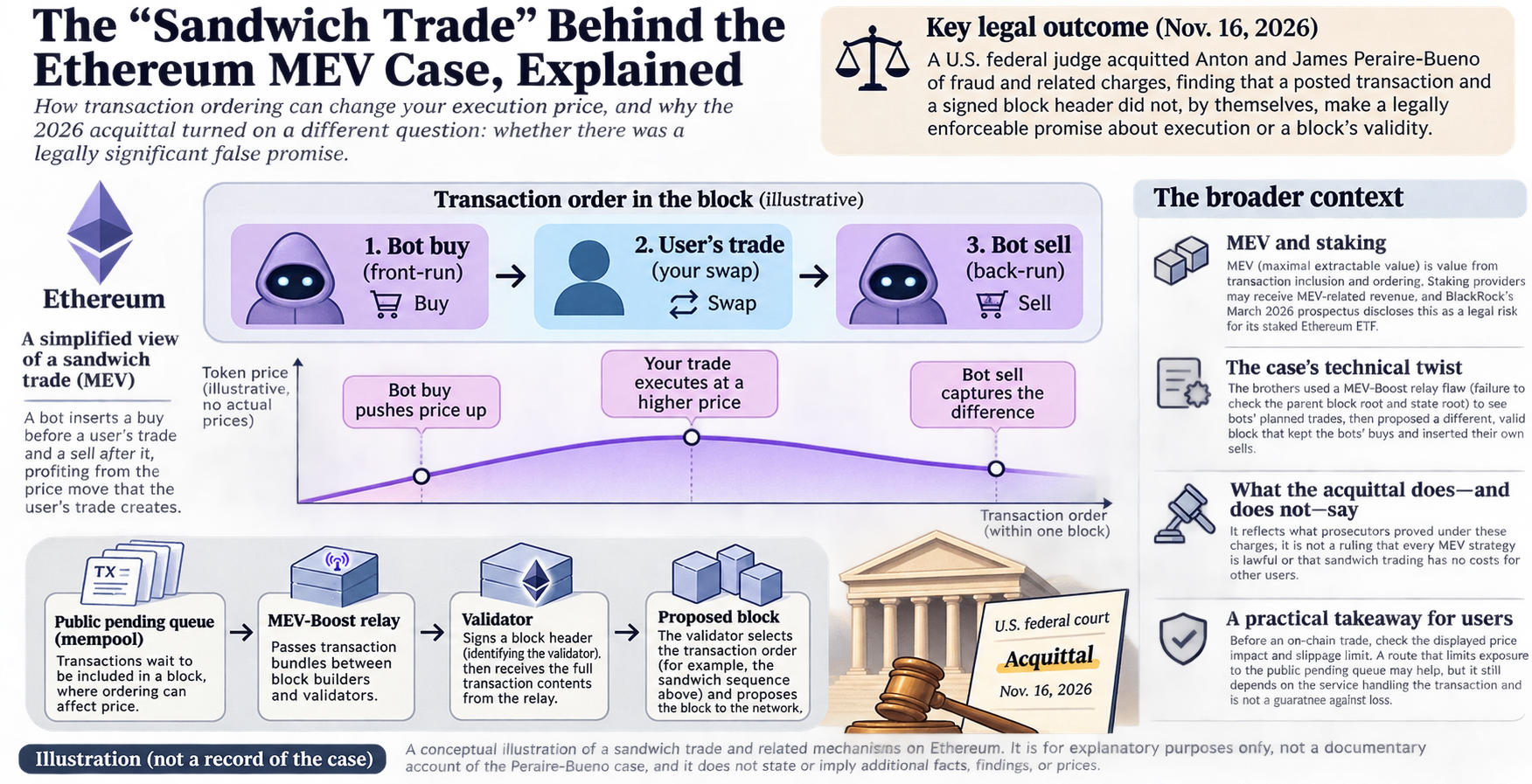
If you trade through a public Ethereum transaction queue, the order in which transactions reach a block can affect your execution price. A November 16, 2026, U.S. federal court acquittal turned on a different question: whether two people who exploited that ordering process had made a legally significant false promise.
As reported on November 19, 2026, a judge acquitted brothers Anton and James Peraire-Bueno of charges arising from a 2023 operation against three professional traders whose bots sought to profit from sandwich trades. Prosecutors had described the operation as taking roughly $25 million in about 12 seconds. That figure is the prosecution’s account, not a separate civil accounting of every loss by the judge.
What happened at the relay
A sandwich bot tries to place a purchase before another trader’s order and a sale after it, profiting when the intervening trade moves the price. The three traders targeted in this case operated bots looking for such opportunities. Their losses do not erase the costs that sandwich trading can impose on other users.
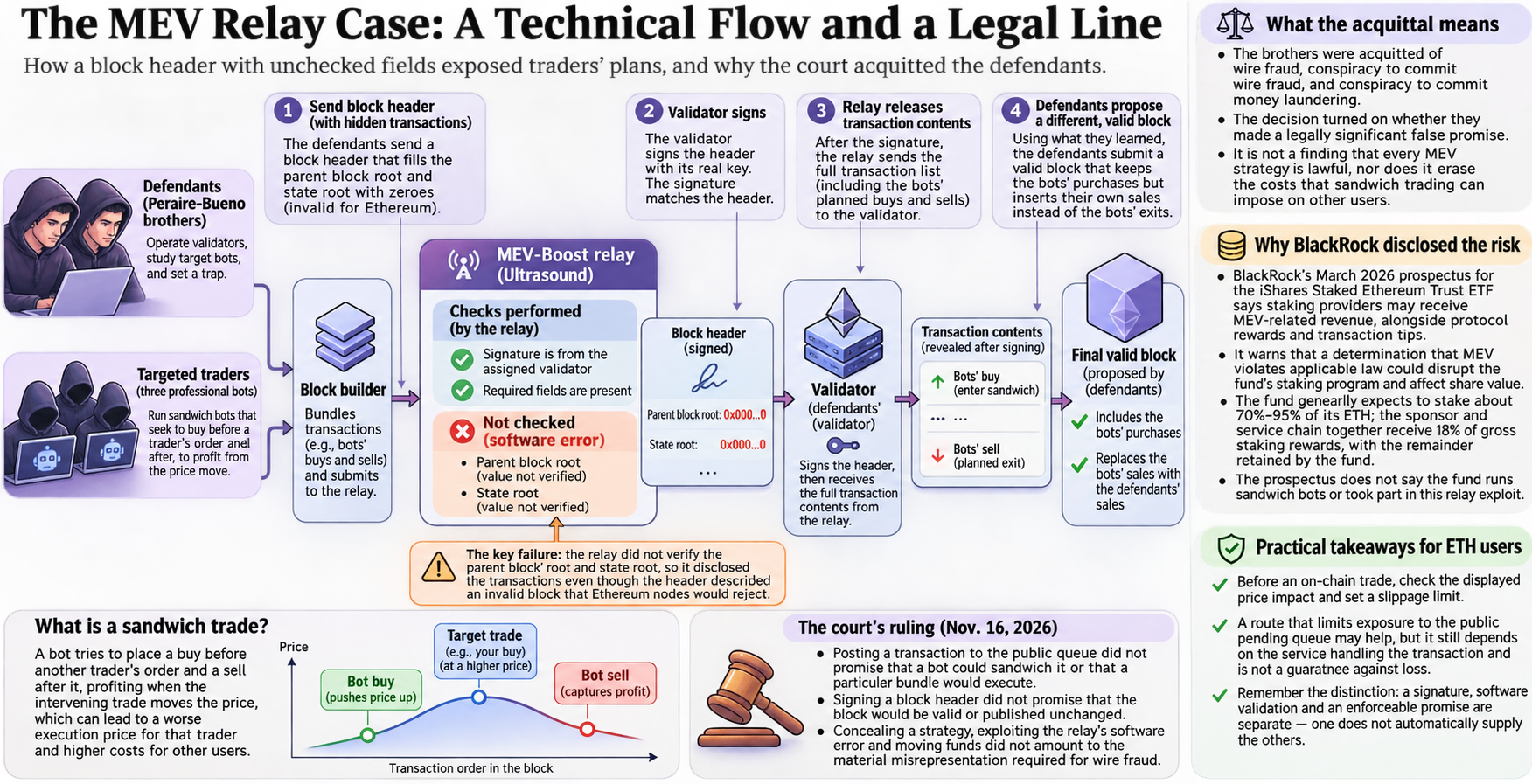
According to the court record, the brothers studied the bots, established 16 validators and, when one of their validators was due to propose a block on April 2, 2023, placed eight decoy transactions in the public pending queue. The bots submitted transaction bundles designed to sandwich those apparent opportunities.
The bundles passed through a MEV-Boost relay. Under that process, a validator initially receives a block header; the relay supplies the full transaction contents after the validator signs. The Ultrasound relay’s software checked that the signature came from the assigned validator and that required fields were present, but did not verify the values of two critical fields: the parent block root and state root.
The brothers filled those fields with zeroes and signed using their real key. The signature matched the header, but Ethereum nodes would reject the resulting block as invalid. The relay nevertheless disclosed the transaction contents. Having seen the bots’ intended purchases and sales, the brothers proposed a different, valid block that retained the bots’ purchases and inserted their own sales instead of letting the bots complete their planned exits.
Why the charges failed
Prosecutors charged the brothers in May 2024 with wire fraud, conspiracy to commit wire fraud and conspiracy to commit money laundering. A nearly four-week trial ended in a mistrial in 2025 when the jury could not reach a unanimous verdict. After a trial without a jury, the judge acquitted them on November 16, 2026.
The judge rejected two proposed sources of a false promise. Posting a transaction to the public queue did not promise that a bot could sandwich it or that a particular bundle would execute. Nor did signing a block header promise that the block would be valid or published unchanged. The relay operator acknowledged that its failure to check the zeroed fields was a software error. The judge found that concealing a strategy, exploiting that error and subsequently moving funds did not substitute for the material misrepresentation required for the wire-fraud charges. The money-laundering conspiracy charge, as brought in this case, depended on proceeds from the alleged wire fraud.
The acquittal is not a finding that every MEV strategy is lawful. It addresses what prosecutors proved under these charges, not every cost imposed by transaction ordering.
Why a staking fund disclosed the risk
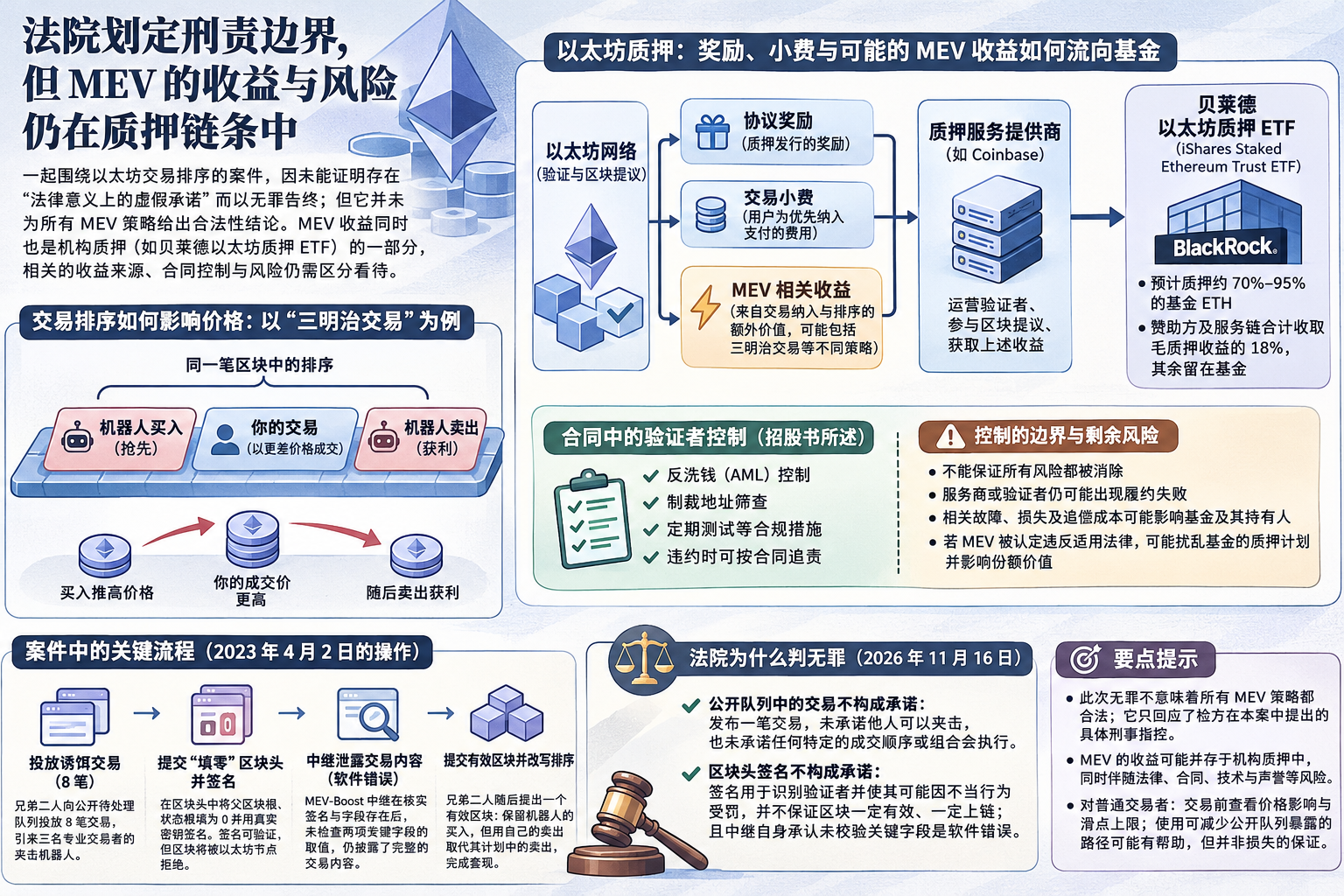
BlackRock’s March 2026 prospectus for the iShares Staked Ethereum Trust ETF says staking providers may receive MEV-related revenue alongside protocol rewards and transaction tips. It warns that a determination that MEV violates applicable law could disrupt the fund’s staking program and affect share value. The prospectus generally anticipates staking about 70%–95% of the fund’s ETH; it says the sponsor and service chain together receive 18% of gross staking rewards, with the remainder retained by the fund.
That disclosure does not say the fund runs sandwich bots or participated in this relay exploit. MEV covers different ways of obtaining value from transaction inclusion and ordering. The prospectus also describes contractual obligations between Coinbase and validators, including anti-money-laundering controls, sanctions-address screening and periodic testing, while warning that failures and recovery costs may still affect the fund and its holders.
For someone holding or using ETH, the practical distinction is between a signature, software validation and an enforceable promise: none automatically supplies the others. Before an on-chain trade, checking the displayed price impact and slippage limit is a manageable precaution. A route that limits exposure to the public pending queue may help, but it still depends on the service handling the transaction and is not a guarantee against loss.