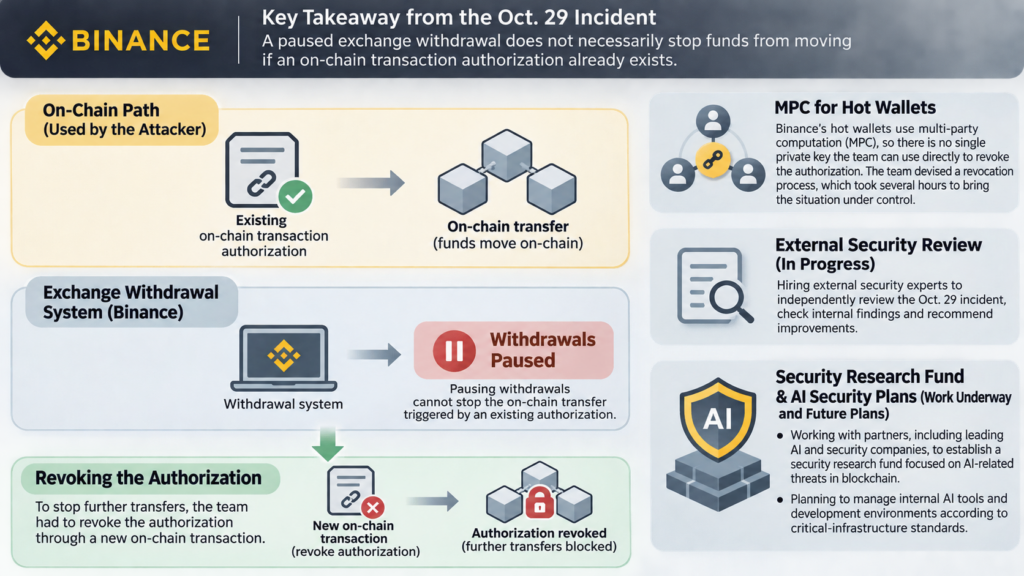
A paused exchange withdrawal does not necessarily stop funds from moving if the relevant authorization already exists on-chain. That was the distinction Binance chief security officer Jimmy Su drew when discussing an October 29 security incident in a Binance X Space conversation reported on November 9, 2026.
According to Su, the attacker used an on-chain transaction authorization that did not pass through Binance’s withdrawal system. Stopping withdrawals therefore could not prevent the transfer; revoking the authorization required a new on-chain transaction.
Su said Binance’s hot wallets use multi-party computation (MPC), so there was no single private key the team could use directly to revoke the authorization. The team had to devise a revocation process, and it took several hours to bring the situation under control.
Su also said Binance was hiring external security experts to independently review the October 29 incident, check its internal findings and recommend improvements. Separately, he said Binance was working with partners, including leading AI and security companies, to establish a security research fund focused on AI-related threats in blockchain. He said the company planned to manage its internal AI tools and development environments according to critical-infrastructure standards. These were described as work underway and future plans, not completed measures.