
For someone receiving crypto into self-custody, a privacy feature is useful only if the wallet can manage its keys safely and make incoming payments accessible. A report published on November 18, 2026 said Pierre, identified as a member of the Ethereum Foundation’s privacy research effort, had announced a working group to advance stealth addresses under ERC-5564. Participants named in the report include the Ethereum Foundation, Umbra developer ScopeLift, stealth-address wallet Fluidkey and hardware-wallet maker Trezor. The group plans to meet every two weeks.
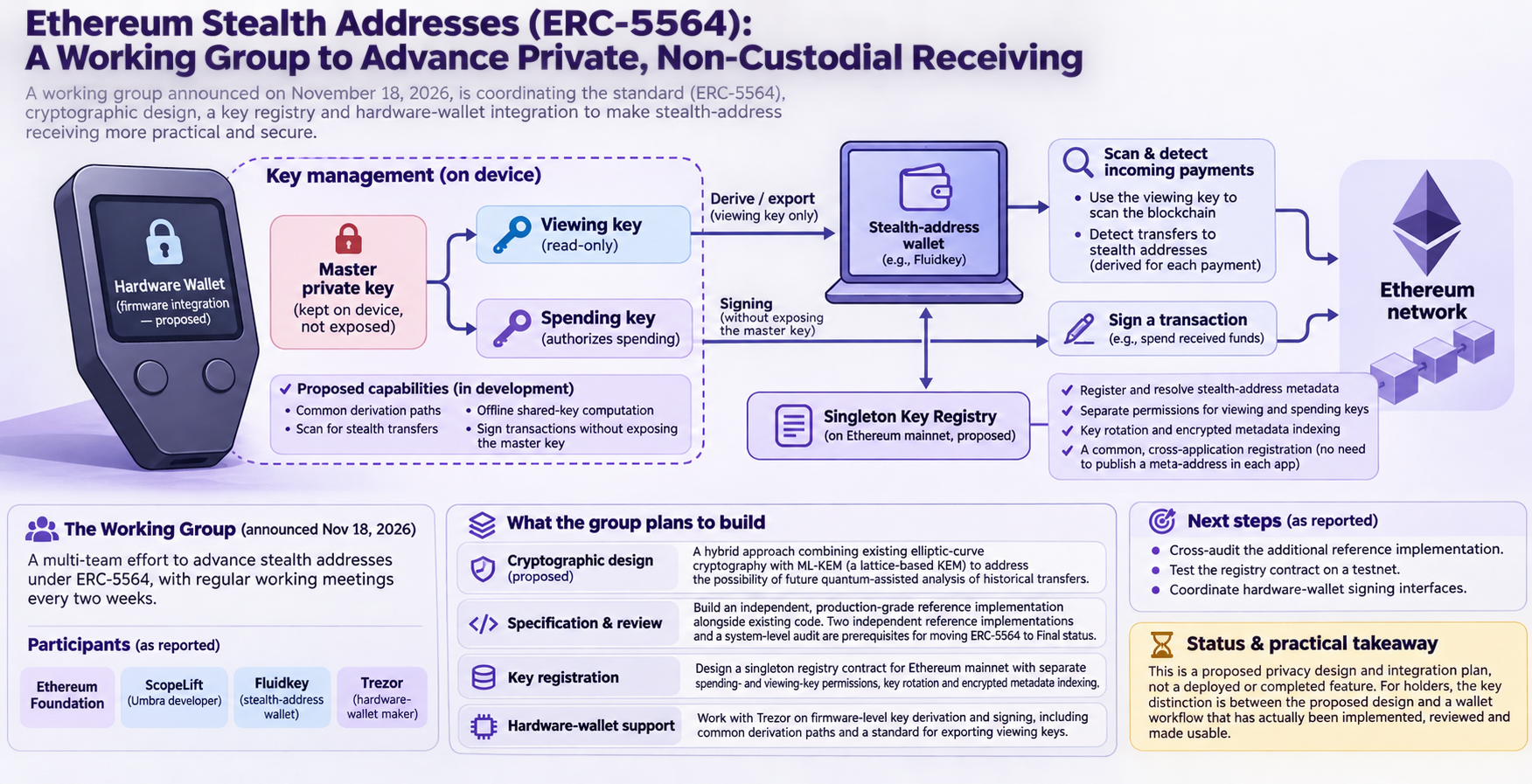
What the group plans to build
The proposed work spans several distinct trust boundaries:
- Cryptographic design: Explore a hybrid approach combining existing elliptic-curve cryptography with ML-KEM, a lattice-based key-encapsulation mechanism, to address the possibility of future quantum-assisted analysis of historical transfers. This is a proposal, not a deployed protection.
- Specification and review: Build an independent, production-grade reference implementation alongside existing code. The report describes two independent reference implementations and a system-level audit as prerequisites for moving ERC-5564 to Final status; it does not say those steps are complete.
- Key registration: Design a singleton registry contract for Ethereum mainnet so compatible applications can use a common way to register and resolve stealth-address metadata. The plan calls for separate spending- and viewing-key permissions, key rotation and encrypted metadata indexing, rather than requiring users to publish a stealth meta-address separately in each application.
- Hardware-wallet support: Work with Trezor on firmware-level key derivation and signing, including common derivation paths and a standard for exporting viewing keys. Offline shared-key computation, scanning for stealth transfers and signing without exposing a master private key are described as intended capabilities, not features confirmed to be available today.
The reported next steps include cross-auditing the additional reference implementation, testing the registry contract on a testnet and coordinating hardware-wallet signing interfaces. For holders, the practical distinction is between the proposed privacy design and a wallet workflow that has actually been implemented, reviewed and made usable.