Moving a stock token into your wallet gives you control of the token. Whether it also gives you ownership of a share, a vote or a dividend depends on how the product was issued. In a November 28, 2026 analysis, imToken identified that distinction as a central question for wallets as exchanges and brokers compete to issue, trade and settle tokenized securities.
Anthropic’s Nasdaq debut illustrates why the distinction matters. According to imToken, before the November 19 listing, an Anthropic pre-IPO contract on OKX traded as high as about 103 USDC, roughly 24% above the $83 offering price. Several crypto platforms introduced tokenized stock products after the listing. A pre-IPO contract, a listed share and a token that tracks the share’s price can all reference the same company without giving their holders the same claim.
Three ways to put a stock onchain
NYSE: preserve the rights attached to the share. In January 2026, Intercontinental Exchange (ICE), the NYSE’s parent, announced plans to combine the exchange’s Pillar matching engine with blockchain systems for post-trade processing, settlement and custody. The proposed platform would support both tokenized shares interchangeable with conventional shares and securities issued digitally from the outset. Shareholders would retain dividend and governance rights. The plan called for 24-hour trading in US-listed stocks and ETFs, fractional shares, immediate settlement and the option to settle payments in stablecoins. On November 2, the NYSE named Securitize, tZERO, Superstate, Broadridge, Computershare and Equiniti as transfer-agent partners. That step connected the project to firms that maintain shareholder records; it was not a launch announcement.
OKX: distinguish the trading venue from the token. OKX and ICE formed their OKXICE joint venture in June 2026, submitted trading-venue plans to the US Securities and Exchange Commission (SEC) in October and, according to imToken, launched the tokenized securities venue on November 23. Separately, OKX introduced Unified Tokenized Stocks in November. That product brings different issuers’ xStocks tokens referencing the same stock into a common order book, with common rules for corporate actions. Users can trade around the clock in USDT and withdraw tokens to Solana or X Layer. Withdrawal changes where the token is held; it does not give the holder equity or voting rights in the underlying company. The product primarily provides price exposure.
Robinhood: hold a debt security backed by shares. In July 2026, Robinhood introduced a new generation of Stock Tokens through its Jersey subsidiary. The issuer buys and holds the corresponding securities as collateral. The customer holds a tokenized debt security, not legal title to the underlying stock or the rights of a shareholder. Robinhood’s brokerage, wallet and onchain services can bring those products to its existing stock investors without changing that legal distinction.
A larger market does not necessarily mean new capital
CoinGecko’s November 2026 report put tokenized stocks’ total market capitalization at $2.71 billion on October 21, up from $1.25 billion in July. Average daily trading volume reached about $402 million, excluding related perpetual contracts.
Those figures measure market size and trading activity, not the source of the money. Stablecoin trading can give investors a way to participate without first funding a conventional brokerage account. But purchases can also draw on idle onchain balances or funds previously used for DeFi lending, liquidity mining and trading native crypto assets. Binance Research found that many tokenized real-world assets were still primarily held or traded rather than used as collateral, in lending or in portfolio strategies.
Nor does growth guarantee that buyers and sellers can trade across venues. Tokens linked to the same stock can have different issuers, legal structures, custodians and redemption terms. A shared reference price does not make those tokens interchangeable across networks or exchanges.
Where the rules apply
United States. According to imToken, the SEC introduced a temporary, conditional Innovation Exemption on September 17, 2026. It allowed qualifying tokenized securities venues to trade certain US-listed stocks through permissioned automated market makers and liquidity pools without conventional exchange registration. The exemption limited eligible securities and trading size, required holders to receive the same rights as holders of conventional shares of the same class, and required publicly auditable smart contracts. For third-party tokenization, the underlying issuer had to receive notice and an opportunity to object. These were conditions for the exemption, not rights conferred on every product marketed as a stock token.
Mainland China. A February 6, 2026 notice from eight authorities, including the central bank, the National Development and Reform Commission and the China Securities Regulatory Commission (CSRC), defined real-world asset tokenization. Notice No. 42 stated that domestic tokenization activities and related intermediary and technical services were suspected illegal financial activities and should be prohibited, except where the competent authority consents under applicable rules and the activity uses specified financial infrastructure.
Separate CSRC guidance issued that day addressed offshore asset-backed securities tokens serviced by cash flows from mainland assets. The mainland entity controlling the underlying assets must file complete materials with the CSRC and comply with cross-border investment, foreign-exchange and network data-security rules. Issuance cannot proceed without the applicable approvals, filings or security review.
Hong Kong. Under its separate regulatory framework, Hong Kong’s Securities and Futures Commission approved the first two tokenized money-market funds for round-the-clock secondary trading on licensed virtual asset platforms on October 26, 2026. On November 2, the Hong Kong Monetary Authority announced a new phase of Project Ensemble supporting 24/7 interbank settlement of tokenized deposits using tokenized central bank money. Participation rose to 12 banks and 20 industry institutions. At a joint event in November, the two regulators described the shift from trials to commercial use in terms of actual transactions connecting investment products, digital money and settlement systems.
What a wallet can tell the holder
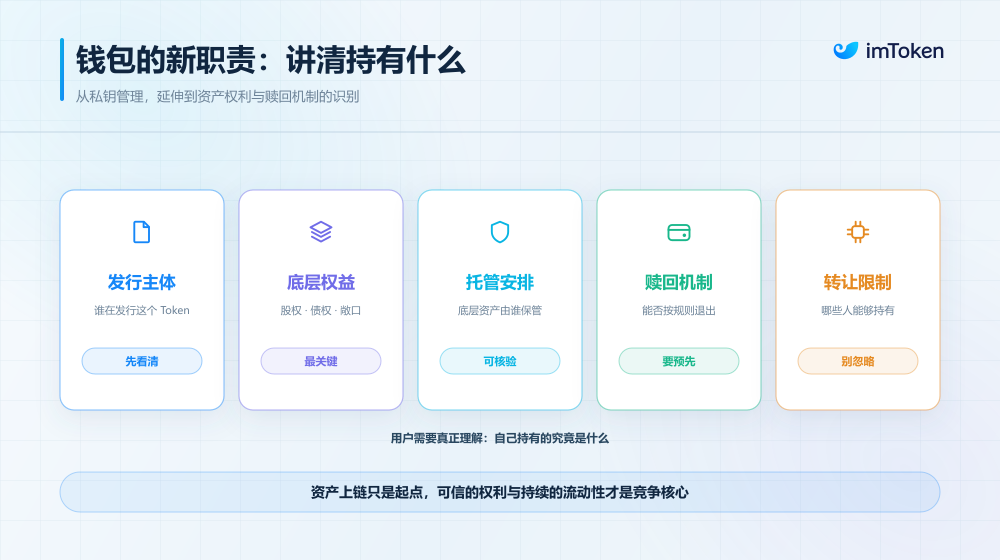
A balance answers “How many tokens do I control?” For a tokenized stock or fund, imToken argued that a wallet should also help answer: Who issued it, what rights does it carry, who holds the underlying asset, how does redemption work, and what limits apply to transfers? Those details let a holder distinguish a share from an issuer’s debt or a price-tracking product. A private key determines who can control the token; it does not determine what the issuer owes its holder.