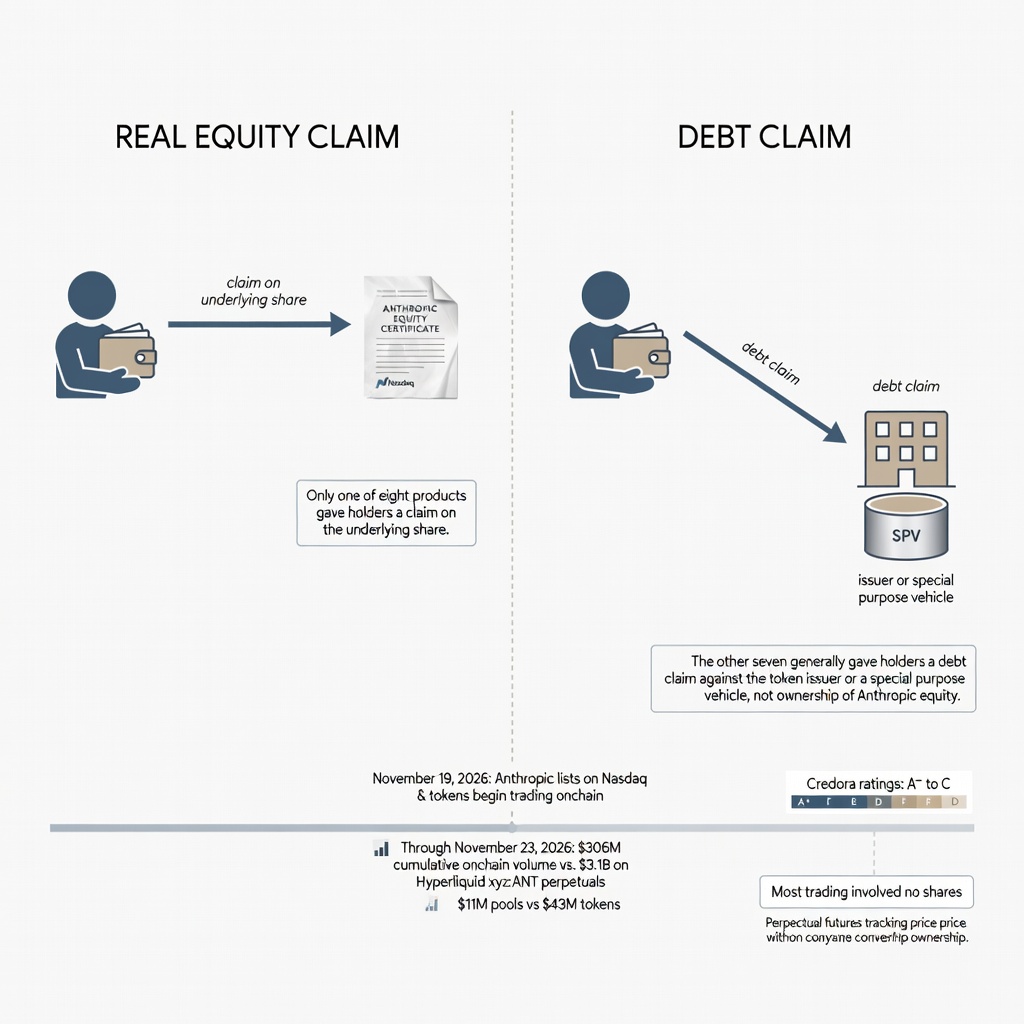
Holding an Anthropic token in a wallet did not necessarily give its holder a claim on Anthropic stock. In a review led by analyst Bernardo Vicente, risk assessment firm Credora Network found that only one of eight tokenized products gave holders a claim on the underlying share. The other seven generally gave holders a debt claim against the token issuer or a special purpose vehicle, not ownership of Anthropic equity.
All eight products began trading onchain on November 19, 2026, the day Anthropic listed on Nasdaq. According to Credora’s research, the company raised $81.3 billion at $83 per share in the largest IPO on record.
What the issuer owes the holder. Each issuer set its own legal terms. The distinction matters if an issuer runs into financial trouble: a holder with a debt claim stands as a creditor, not as an owner of the underlying shares. The useful check is what the terms say the holder can claim, and from whom—not whether the token bears the stock’s name.
Credora rated the eight products between A− and C on a scale from A+ to D. Alongside legal backing, the ratings considered issuer reliability, audits and risks associated with smart contract access. Earlier analyses of tokenized Nvidia products found that most were also debt claims and that prices diverged by as much as 6.3% when traditional markets were closed. That figure concerned the Nvidia products, not the Anthropic tokens.
Most trading involved no shares. From the listing through Monday, November 23, the eight wrappers recorded approximately $306 million in cumulative onchain volume. Over the same period, Hyperliquid’s xyz:ANT perpetual futures contract traded more than $3.1 billion. Unlike the wrapper with a share claim, the perpetual tracks the stock price without expiring or conveying any claim on a share.
Trading volume was also distinct from available liquidity: the onchain pools held about $11 million in liquidity against $43 million in outstanding tokens.