For holders who stake ORCA for xORCA, the exchange’s trading volume tells only part of the story. In the 30 days ended November 18, 2026, Orca’s flagship SOL-USDC pool handled 41.5% of volume but generated just 18.9% of swap fees, according to Alea Research’s analysis of Orca data. And under a governance change that took effect October 30, only 10% of the protocol’s fee share goes to xORCA buybacks, down from 40%.
Where the fees came from
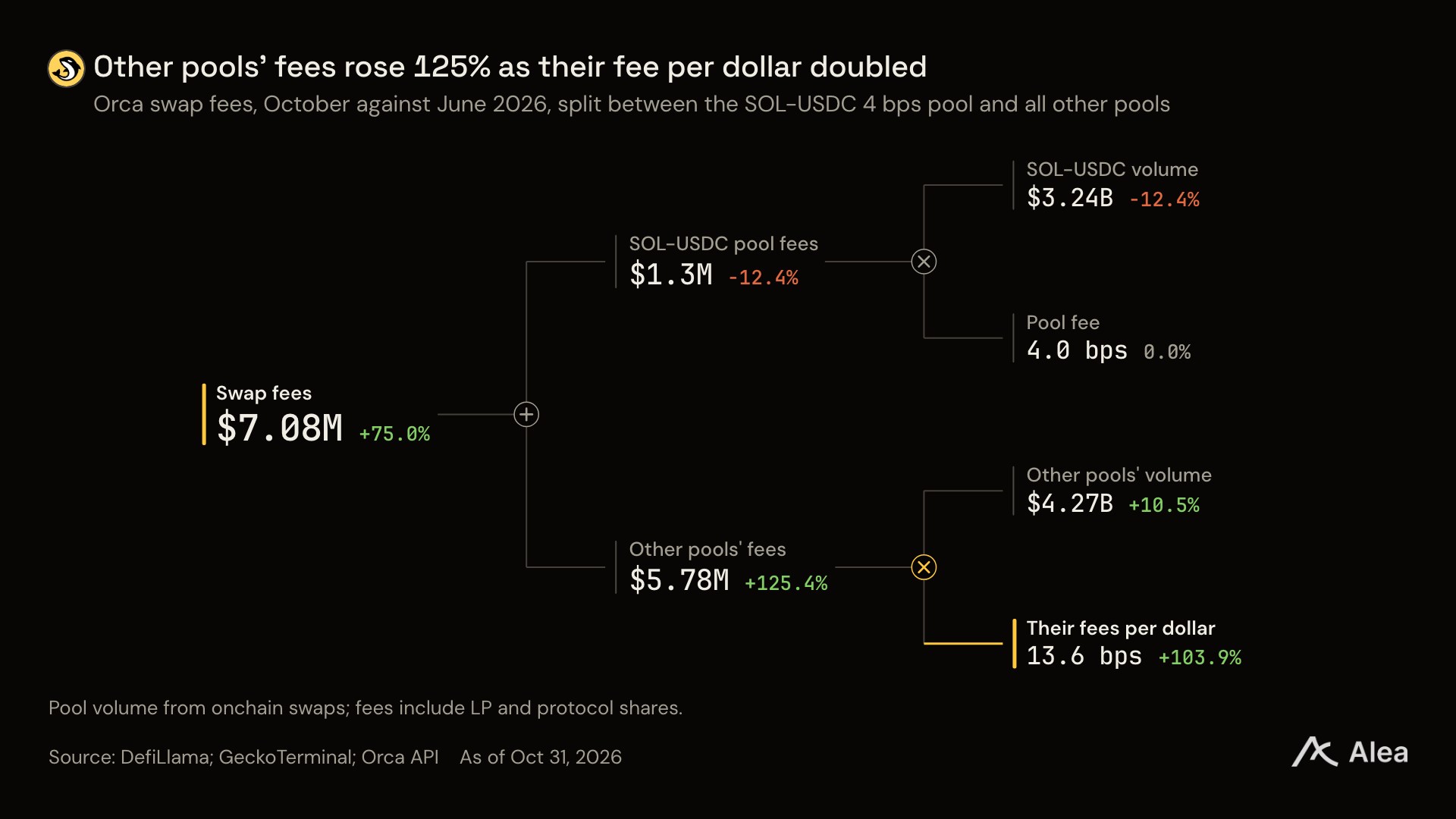
The flagship pool charged 4 basis points, or 0.04%, per swap. The other pools charged about 12 basis points on average and accounted for just over 81% of fees. ZEC pools alone generated 16.8% of fees on 8.8% of volume, nearly matching the flagship pool’s fee contribution. Tokenized equities and other real-world assets contributed another 14.0% of fees, mostly from 95 tokens representing public stocks and stakes in private companies issued by Backpack Securities, xStocks and PreStocks.
Pool design mattered as well as asset choice. Across asset categories, pools that automatically raised fees during sharp price moves generated nearly half of all fees on just one-sixth of volume. By contrast, stablecoin-to-stablecoin pools held just over half of Orca’s liquidity as of November 18 but generated only 1.0% of fees. That worked out to an annualized fee yield of about 0.5% for their liquidity providers, before accounting for token incentives.
Across all pools, Orca traders paid a volume-weighted average of 8.8 basis points, the lowest among the four major Solana exchanges in Alea’s comparison that allowed anyone to provide liquidity. Raydium averaged 11.3 basis points on roughly 20% more volume. Meteora’s DLMM and PumpSwap charged several times Orca’s average; their measurement periods ended one day earlier. The comparison excluded proprietary automated market makers that supply and price their own liquidity.
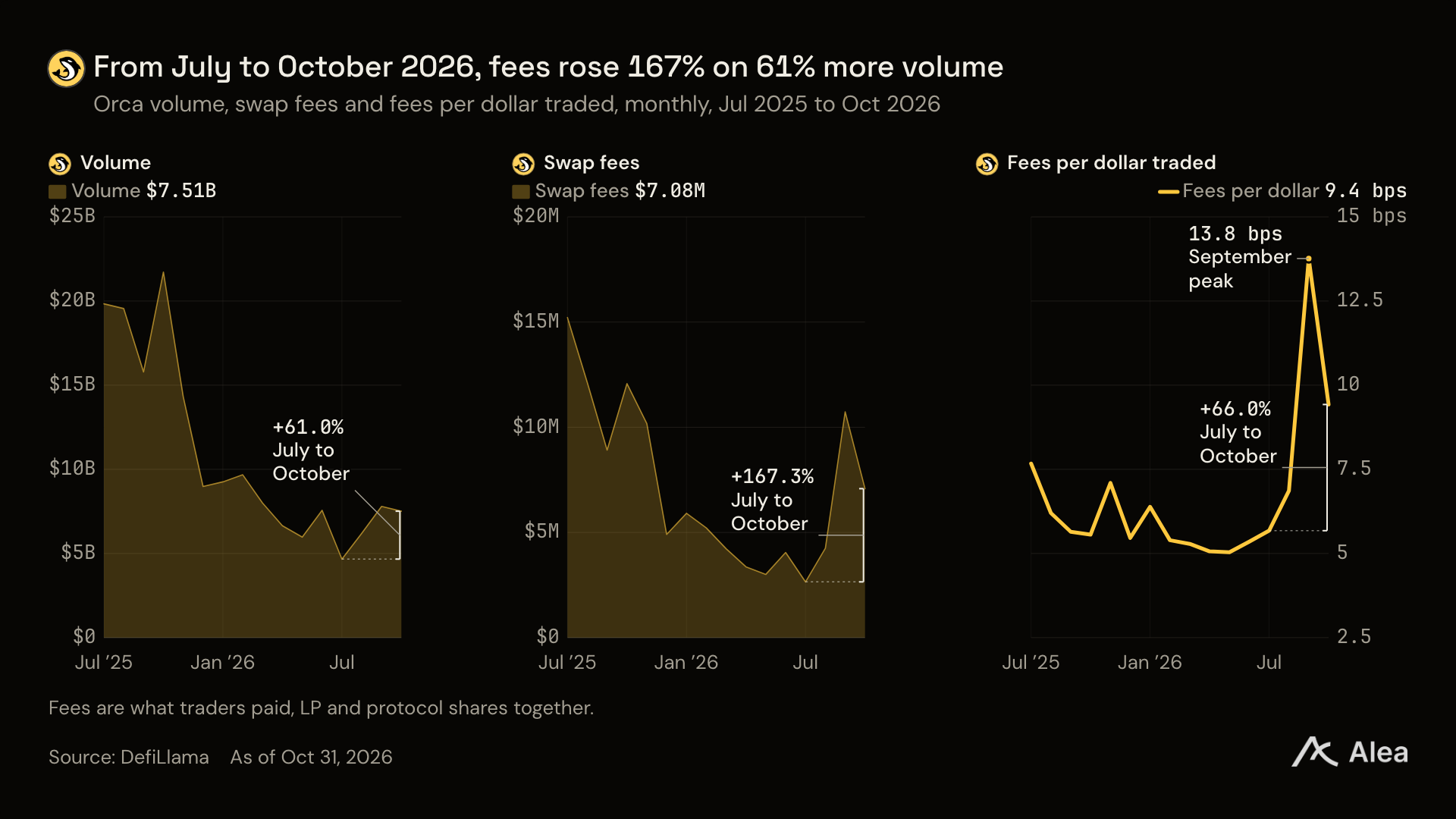
The change in trading mix helps explain why October generated 75% more fees than June on roughly the same total volume. Flagship pool volume fell by one-eighth, while volume elsewhere rose about 10% and the average fee rate in those other pools doubled. SOL-PUMP and two ZEC pools, each charging a base rate of at least 16 basis points, accounted for at least a quarter of the increase in fees outside the flagship pool. From July’s low to October, overall volume rose 61% and fees rose 167%.
Who controls the fee income
On Orca, liquidity providers choose a price range and earn fees only while the market price is within it. They keep 87% of swap fees. Of every 100 units paid in fees, the remaining 13 break down into 12 for the protocol and one for the Climate Fund. The October vote changed how the protocol’s 12-unit portion is spent, not the liquidity providers’ share.
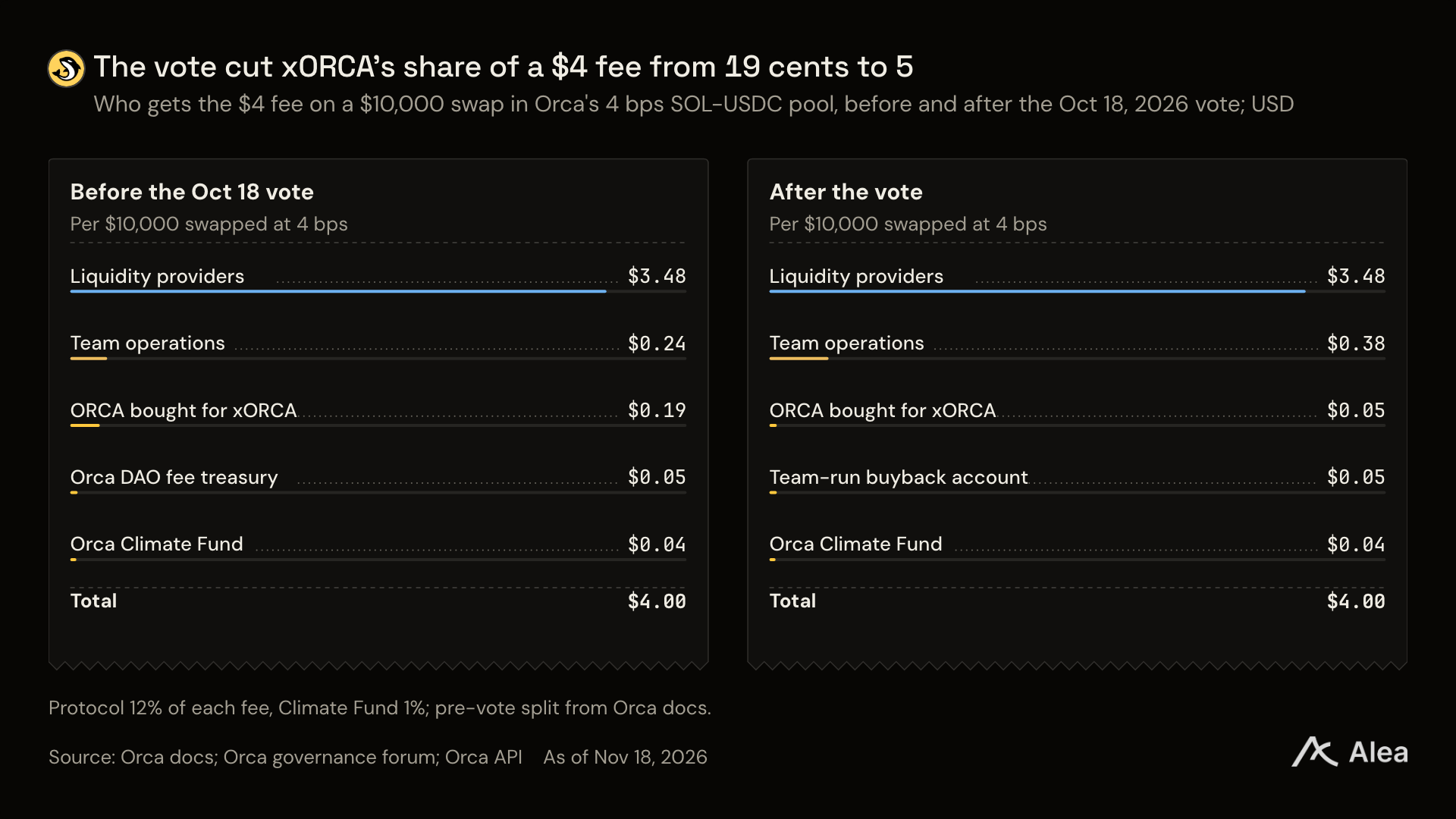
Orca and lending protocol Loopscale announced their merger under the Formation name on October 7. Token holders approved its funding on October 18. When the new split took effect onchain on October 30, Formation’s development and operations allocation rose from 50% to 80% of the protocol share. The xORCA buyback allocation fell from 40% to 10%, and the 10% previously allocated to the DAO fee treasury went instead to a separate, team-controlled buyback account. Daily USDC spending on buybacks for xORCA stakers subsequently fell by about four-fifths, Alea found.
The separate account is not a second guaranteed distribution to stakers. The team can use it to buy ORCA and then burn the tokens, add them to the xORCA staking pool or award them to core contributors subject to a four-year linear lockup. The team committed to reporting on buybacks through an audit every six months. The same vote moved 14.2 million ORCA, about one-fifth of total supply, from the community treasury to a team-controlled account reserved for potential strategic acquisitions. The deal terms were not disclosed.
What the valuation measures
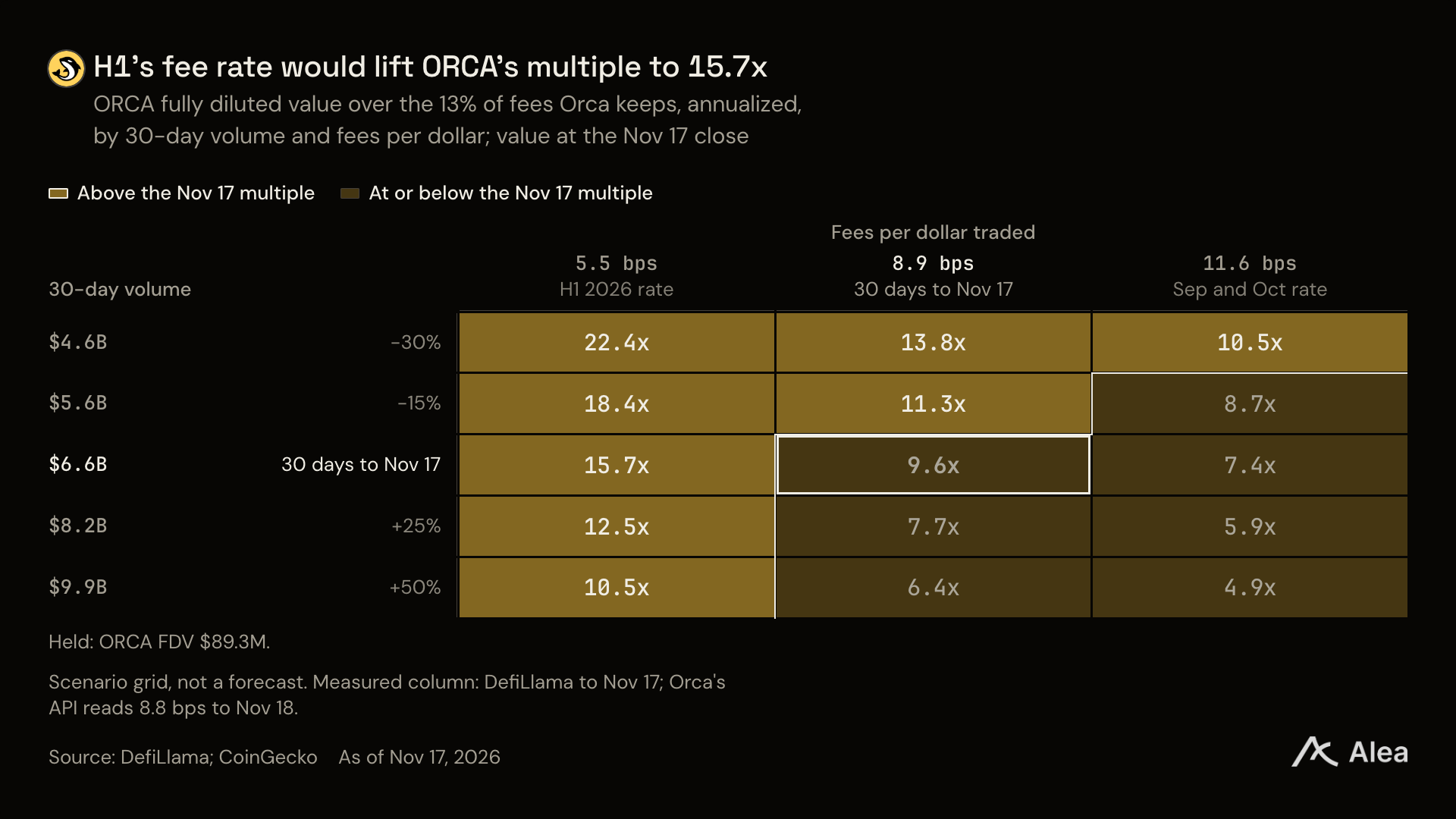
At the November 17 close, ORCA’s fully diluted valuation was 9.6 times annualized retained swap fees, using the trailing month’s pace and the full 13% retained, including the Climate Fund. Counting only the protocol’s 12% share put the multiple at 10.4. Neither figure measures distributions to stakers.
Measured against xORCA buybacks alone, running at about $860,000 annualized, the multiple was 104 times. Including the discretionary team buyback account lowered it to 52 times, but that calculation includes funds the team can use for contributor compensation.
The fee rate also changes the comparison. Orca averaged about 5.5 basis points per dollar traded in the first half of 2026, versus 9.4 in October. In Alea’s scenario holding volume constant, a return to the first-half fee rate would reduce retained fees by about two-fifths and raise the 9.6 multiple to 15.7. That was a sensitivity calculation, not a forecast. On the broader measure of fully diluted valuation against annualized protocol revenue before holder distributions, Alea put PUMP at 4.2 times, MET at 8.5, JUP at 22.5 and RAY at 33.4.
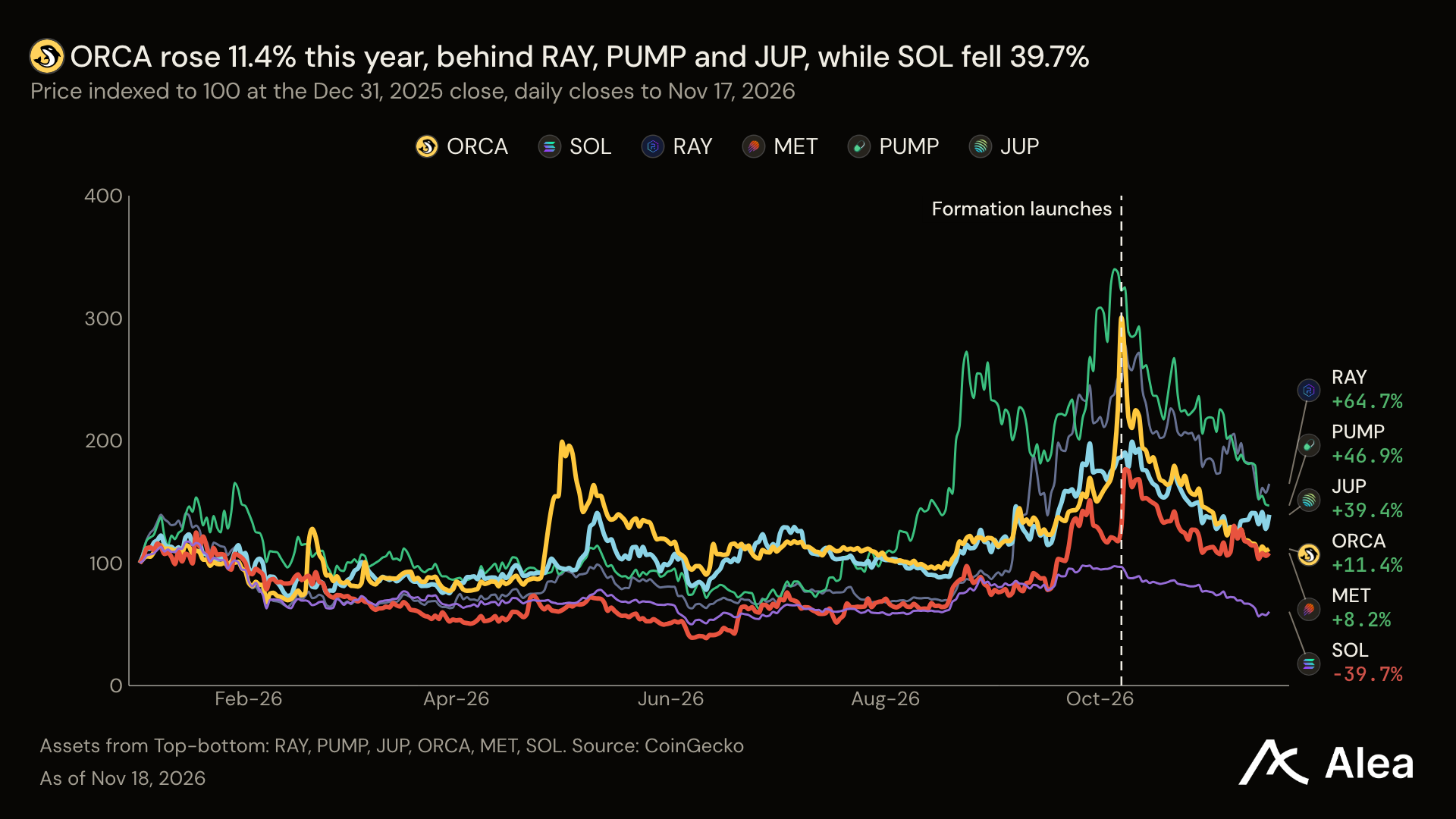
ORCA was up 11.4% for the year through November 17, against a 39.7% decline for SOL. That year-to-date figure masks two rallies in which ORCA doubled, one in late April and another from September 29 to October 6, followed by a 63% decline from its high by mid-November. RAY, PUMP and JUP posted larger year-to-date gains than ORCA; MET lagged it.
What Formation adds, and what remains separate
Formation outlined a sequence for new assets: establish an Orca trading pool, then add a Loopscale lending market and vault strategies. It opened a waitlist for a unified interface on November 17. At Solana Breakpoint in mid-November, Formation also announced leveraged vaults for EPIC assets on R3’s Corda network, launch support for Superstate asset issuances and a partnership with DigiFT.
The lending business carries distinct risks. On November 5, an attacker obtained about $412,000 in undercollateralized borrowing from a Loopscale vault. That was the amount borrowed, not a confirmed depositor loss. Loopscale said that day that no user had lost deposited principal. It reopened on November 7 after a two-day pause. Dollar-denominated deposits had already fallen nearly 10% between September 30 and the day before the incident. From reopening through the November 17 close, deposits fell nearly another quarter, while SOL fell 16%.
A separate initiative concerns the software rather than the lending business. On November 9, Formation Securities LLC, a subsidiary of Valcrest, Inc., announced plans under an SEC exemption for a U.S. tokenized-securities venue restricted to approved wallets. The proposed venue would license Orca’s pool software and smart router. Formation Securities named Exodus, Forward Industries and Galaxy as signed launch issuers and said it expected trading to begin in early 2027; trading had not yet launched. Elsewhere in the sector, Kamino relaunched on November 16 as an app aggregating more than 100 real-world assets, and Jupiter opened its lending liquidation market to Bullish-issued tokens the same day.
For xORCA holders, the distinction is between products that share a team or software and revenue that actually funds buybacks. Loopscale lending revenue remained outside Orca’s swap-fee distribution, and as of November 18 its lending fee schedule had not been disclosed.