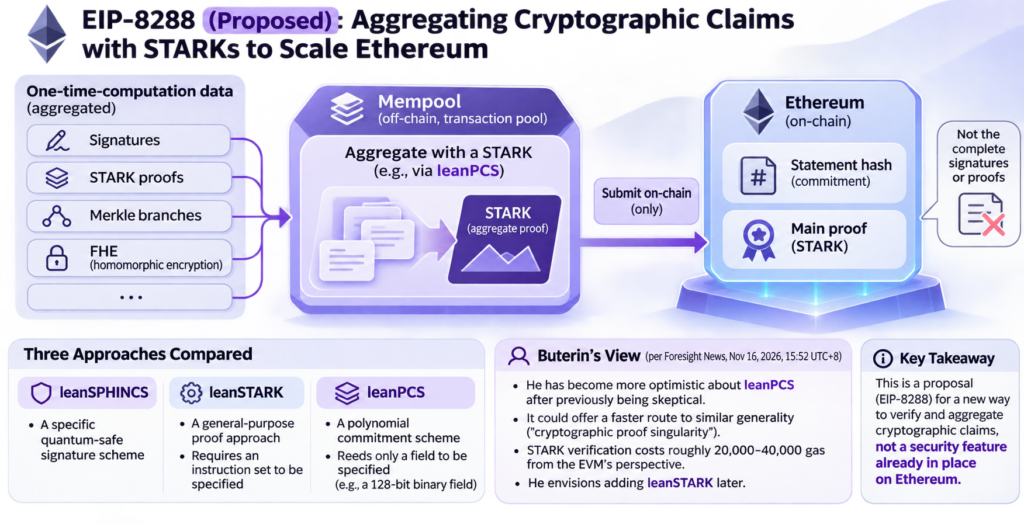
For people holding assets on Ethereum, the distinction is between a proposed way to verify cryptographic claims and a security feature already in place. In a report published on November 16, 2026, at 15:52 (UTC+8), Foresight News said Vitalik Buterin had become more optimistic about leanPCS after previously being skeptical.
Buterin described EIP-8288 as an approach to aggregating STARK proofs in the mempool. For data such as signatures, STARKs, Merkle branches and FHE that need to be computed only once, the aim is large-scale expansion while putting only a statement hash and a main proof on-chain—not the complete signatures or proofs. This is a proposal, not a claim that the arrangement is already operating on Ethereum.
He compared three approaches: leanSPHINCS, a specific quantum-safe signature scheme; leanSTARK, a general-purpose proof approach that requires an instruction set to be specified; and leanPCS, a polynomial commitment scheme. According to Buterin, leanPCS needs only a field to be specified, such as a 128-bit binary field. He suggested that this could offer a faster route to similar generality, with STARK verification costing roughly 20,000–40,000 gas from the EVM’s perspective. He envisioned adding leanSTARK later.