For anyone relying on a smart contract to distribute funds, a successful transaction does not always mean every payment inside it succeeded. As reported on November 17, 2026, testing of Ethereum’s proposed Glamsterdam upgrade had identified a potential compatibility issue in Juicebox V6 payment contracts.
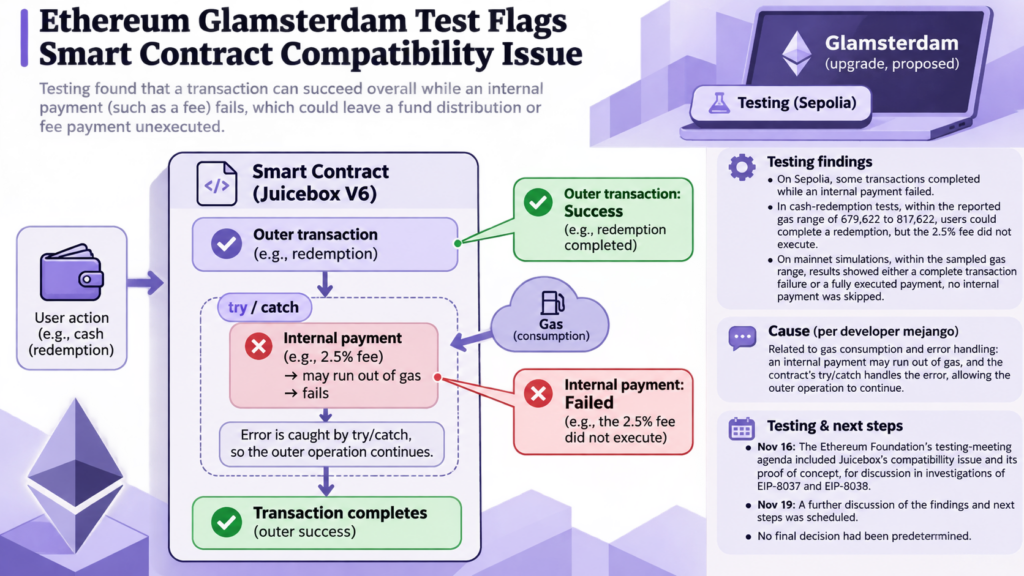
In simulations on the Sepolia test network, some transactions completed while an internal payment failed. That could leave a fund distribution or fee payment unexecuted. In cash-redemption tests using the reported gas range of 679,622 to 817,622, users could complete a redemption, but the 2.5% fee that should have been paid did not execute.
Developer mejango attributed the behavior to gas consumption and error handling: an internal payment may run out of gas, while the contract’s try/catch handles the error and allows the outer operation to continue. Comparable mainnet simulations showed either a complete transaction failure or a fully executed payment within the sampled gas range; they did not show an internal payment being skipped.
The Ethereum Foundation’s November 16 testing-meeting agenda included the compatibility issue raised by Juicebox and its proof of concept for discussion in investigations of EIP-8037 and EIP-8038. At the time of the November 17 report, a further discussion of the findings and next steps was scheduled for November 19. No final decision had been predetermined.