For anyone planning to hold ETH over the long term, the question is not whether a quantum-safe wallet switch is available today. It is whether Ethereum can introduce new signature options without disrupting accounts and contracts that already work. As reported on November 10, 2026, researchers were pursuing a faster transition than the Ethereum Foundation’s formal timetable, while a delayed upgrade showed how difficult that transition could be.
Two timelines, not one deadline
At Devcon 8 in Mumbai, Ethereum Foundation researcher Justin Drake expressed a goal of completing a quantum-resistant and “post-AI” transition by December 2028. The Foundation’s published plan instead targeted three layers of quantum resistance by December 2029; it said that date would not change before a review with external experts in January 2027. The earlier date was a research goal, not an adopted replacement deadline.
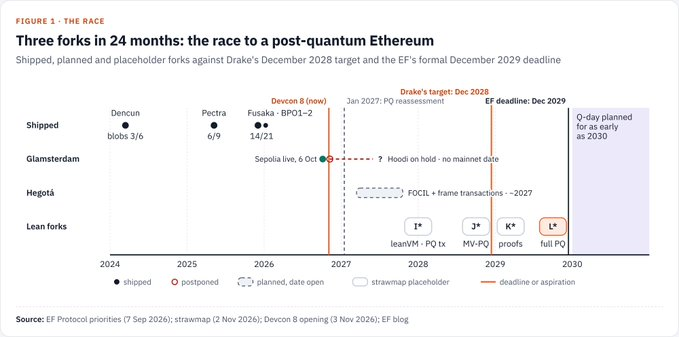
The draft sequence depends on successive hard forks. Hegotá, planned for 2027, would introduce frame transactions, allowing accounts to define how they authorize transactions and providing a path away from ECDSA signatures. A later fork, provisionally called I*, would add leanVM and quantum-resistant “lean” transactions. J* would add hash-based validator signatures and quantum-resistant data sampling—the Foundation’s proposed “minimum viable post-quantum” milestone. Further changes were assigned to K* and L*.
That sequence makes delivery speed a security issue. The source calculates that reaching Drake’s goal after Glamsterdam would require three hard forks in 24 months. The Foundation’s December 2029 plan would also require a rapid cadence across the remaining forks. Neither timetable, as of the original report, was a completed upgrade schedule.
Why an existing upgrade matters to wallets
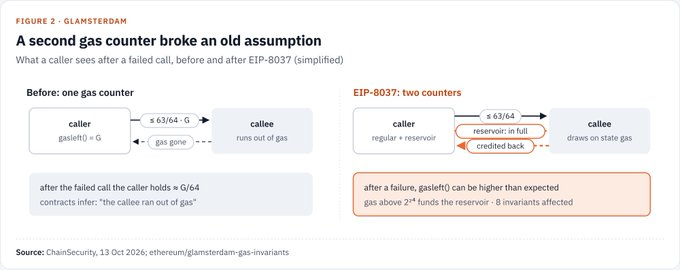
Glamsterdam illustrated the compatibility risk. A proposed gas repricing, EIP-8037, changed costs and gas-handling behavior that deployed contracts could observe. ChainSecurity warned that some error handlers previously stopped by insufficient gas might instead complete, bypassing commonly used checks against malicious interference. The Foundation identified eight broken invariants, and an AllCoreDevs summary counted 13 affected DeFi projects. The Hoodi testnet was postponed without a new Hoodi or mainnet date in the report. All Core Devs coordinator Nixo wrote that the issue would “very likely” move Glamsterdam’s mainnet launch into 2027.
This matters to the signature transition because the proposed Hegotá frame transactions listed EIP-8037 as a requirement. A way to change account authorization still has to be delivered through upgrades that preserve existing behavior.
Making larger signatures usable
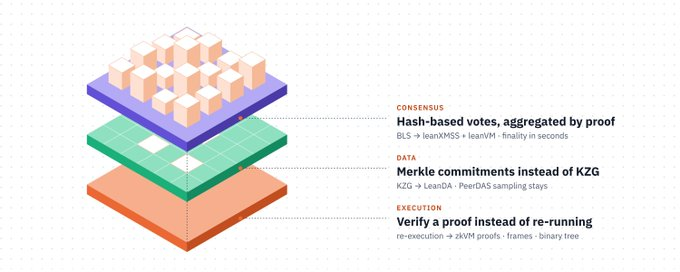
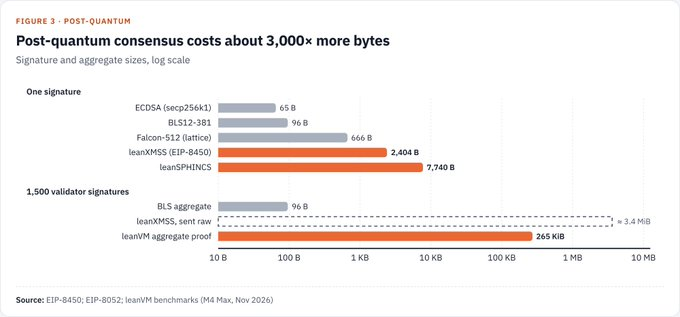
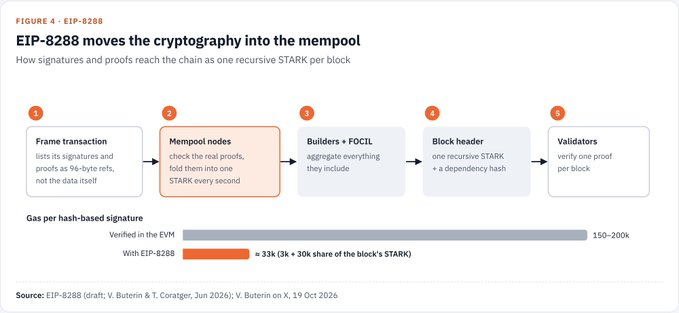
Hash-based signatures bring a size and cost trade-off. The source describes leanSPHINCS signatures of 7,740 bytes, with direct verification costing an estimated 150,000–200,000 gas. Draft EIP-8288 proposes checking signatures and proofs as transactions enter the mempool, aggregating them, and putting one recursive proof in a block rather than carrying every large signature on-chain. Its estimated cost for an aggregated leanSPHINCS signature is about 33,000 gas.
Those are proposal estimates, not costs wallet users can rely on today. EIP-8288 remained a draft in the original report: some dependencies were still unspecified, its STARK dependency was only reserved, and the authors acknowledged a potential increase in mempool denial-of-service risk. The source also cautioned that leanVM’s end-to-end formal-verification claim did not mean every implementation and recursive-proof soundness question was settled or production-ready.
The practical holding lesson is to distinguish a path for future account migration from a migration already available. As of November 10, 2026, the key checks were whether Glamsterdam’s repricing issue could be resolved, whether Hegotá could deliver frame transactions, and whether subsequent signature and proof proposals could pass their remaining security work. No current wallet setup was described as eliminating those risks.
Source: panewslab.com (originally published 2026-11-10 10:59 UTC+8)